Process Governance & Ethical Change
 ACTSol and Associates
Process governance and ethical change: ownership, approvals, compliance, transparency, accountability, controls, and leadership so process changes
In every organization, processes decide how work gets done. They define how decisions are made, how approvals are taken, how customers are served, how risks are managed, and how people are held accountable. But processes cannot succeed merely because they are documented. They need ownership, discipline, review, and ethical judgment. This is where process governance becomes essential.
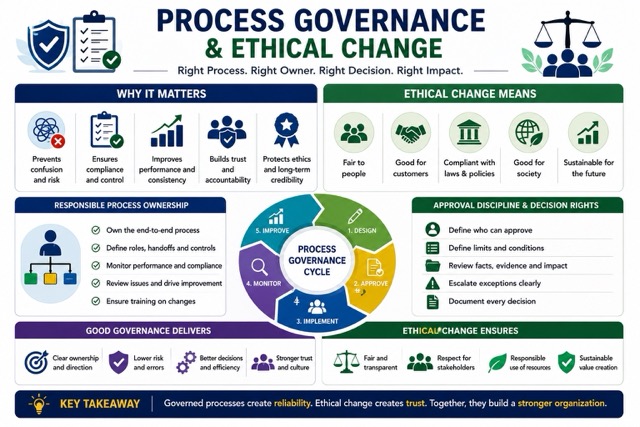
Process governance is the system through which an organization ensures that its processes are properly designed, approved, implemented, monitored, improved, and controlled. It gives clarity on who owns a process, who can change it, who approves exceptions, how compliance is checked, and how decisions are escalated. When governance is weak, even well-written SOPs become informal guidelines. When governance is strong, processes become reliable management tools.
This topic fits naturally under governance, leadership, and transformation strategy in the broader blog series on process and change management.
This topic fits naturally under governance, leadership, and transformation strategy in the broader blog series on process and change management. Ethical change means that process changes are not made only for speed, cost reduction, or management convenience. They are made responsibly, considering employees, customers, vendors, regulators, society, and long-term organizational credibility. Ethical change asks an important question: “Is this change not only efficient, but also fair, transparent, compliant, and sustainable?”
Why Process Governance Matters
Many organizations face process problems not because they lack SOPs, but because they lack governance. A process may exist, but no one owns it. A policy may be approved, but no one monitors compliance. A workflow may be designed, but exceptions are handled informally. A change may be implemented, but affected employees are not trained. Over time, this creates confusion, risk, duplication, blame, and loss of control.
Process governance creates order. It ensures that every important process has a defined owner, clear approval authority, measurable performance expectations, documentation control, and review discipline. It also ensures that changes are not made casually or secretly. A change in procurement approval limits, payroll processing, customer complaint handling, safety reporting, vendor selection, or quality inspection can have serious implications. Governance ensures that such changes are reviewed from operational, financial, legal, compliance, and ethical angles.
Without governance, process changes may be driven by individual preference. One manager may bypass approval to save time. Another may change a reporting format without informing stakeholders. A department may introduce a shortcut that creates risk for finance, quality, safety, or customer service. These may appear small initially, but they can gradually weaken organizational discipline.
Good governance prevents this by making process ownership and decision-making visible.
Responsible Process Ownership
Every critical process must have a process owner. A process owner is not merely the person who performs the activity. The owner is responsible for the health, performance, compliance, and improvement of the process.
For example, the HR Head may own the recruitment process, but hiring managers, interview panel members, finance, and administration may all participate in it. Similarly, the Procurement Head may own vendor onboarding, but quality, finance, legal, and operations may have important roles. Process ownership ensures that someone is accountable for end-to-end performance rather than only departmental tasks.
Responsible process ownership includes:
- Ensuring that the process is clearly documented.
- Defining roles, responsibilities, and handoffs.
- Monitoring process performance through KPIs and KRIs.
- Ensuring compliance with internal policies and external regulations.
- Reviewing deviations, complaints, delays, and failures.
- Initiating improvements where required.
- Ensuring employees are trained on process changes.
A common mistake in organizations is confusing functional authority with process ownership. A department head may control a team, but a process often cuts across departments. For instance, order-to-cash involves sales, credit, operations, dispatch, billing, finance, and collections. If no one governs the complete process, each department may optimize its own work while the customer experience suffers.
Governance therefore encourages end-to-end thinking. It asks: Who owns the complete flow? Who is responsible when the process fails? Who has authority to improve it? Who reviews performance? Who ensures ethical conduct?
Approval Discipline and Decision Rights
Approvals are one of the most visible elements of governance. They define who has the authority to approve an activity, transaction, exception, expense, change, or deviation. But approvals should not exist merely as signatures. They must represent informed decision-making.
A strong approval framework defines:
- Who is authorized to approve.
- Who is authorized to approve.
- What documents or evidence must be reviewed.
- What limits apply.
- What exceptions are allowed.
- What escalation is required.
- How approvals are recorded.
For example, a purchase order may require approval based on value, budget availability, vendor status, technical need, and compliance with procurement policy. A hiring decision may require approval based on manpower plan, role justification, budget, compensation range, and organization structure. A process change may require approval from the process owner, compliance team, IT team, and business head depending on its impact.
Poor approval governance creates two opposite problems. In some organizations, approvals are excessive and slow. Every decision moves through too many levels, causing delay and frustration. In others, approvals are too informal, creating risk, favoritism, leakage, and audit concerns. Good governance balances control with speed.
Ethical change requires that approval decisions are not biased, hidden, or arbitrary. The basis of approval must be transparent. Decision-makers must avoid conflicts of interest. Exceptions must be recorded. Approval authority must not be misused to bypass policy or favor selected individuals, vendors, or departments.
Compliance as a Governance Responsibility
Compliance is not only the responsibility of the legal or audit department. It is built into daily processes. Payroll must comply with labour laws. Procurement must comply with tax, contractual, and ethical sourcing requirements. Safety processes must comply with statutory and operational standards. Finance processes must comply with accounting, tax, and internal control requirements. Data processes must comply with privacy and cybersecurity expectations.
Process governance ensures that compliance is embedded into the workflow. It converts regulatory and policy requirements into practical steps, checklists, approvals, records, and controls. For example, instead of merely saying “vendor due diligence must be done,” governance requires a defined vendor onboarding checklist, supporting documents, approval trail, risk classification, and periodic review.
This is important because employees may not always understand the compliance impact of their actions. A small shortcut in document verification may later become a legal issue. A missing approval may become an audit observation. A verbal commitment to a customer may become a contractual dispute. A manual change in system data may become a control failure.
Governance reduces such risks by making compliance operational. It ensures that people do not need to interpret rules individually every time. The process itself guides them toward compliant behavior.
Transparency in Process and Change Decisions
Transparency means that people understand how decisions are made, why changes are introduced, and what impact those changes will have. It does not mean that every employee must approve every decision. It means that relevant stakeholders are informed, consulted where needed, and given clarity.
When process changes are introduced without transparency, resistance increases. Employees may feel that decisions are imposed. Managers may interpret changes differently. Customers or vendors may receive inconsistent communication. Compliance teams may discover changes only after problems occur.
Transparent process governance ensures that change decisions are documented and communicated. For important process changes, organizations should clarify:
- What is changing?
- Why is it changing?
- Who approved the change?
- Who is affected?
- What risks were considered?
- What training or support will be provided?
- From when will the change apply?
- How will compliance be monitored?
For example, if an organization changes its expense reimbursement process from manual approval to system-based approval, employees must understand the new steps, timelines, documentation requirements, approval flow, and escalation path. If they are not informed properly, the change may create anxiety and complaints even if the system is technically correct.
Transparency builds trust. People may not always agree with every change, but they are more likely to accept it when they understand the reason, logic, and controls behind it.
Ethical Change Decisions
Change management often focuses on adoption, speed, and implementation. Ethical change adds another layer: responsibility. It asks whether the change respects fairness, dignity, compliance, and long-term consequences.
For example, automation may improve efficiency, but ethical governance asks how affected employees will be reskilled, redeployed, or communicated with. A new performance dashboard may improve accountability, but ethical governance asks whether the metrics are fair and whether employees have control over the outcomes being measured. A cost reduction process may improve margins, but ethical governance asks whether safety, quality, vendor fairness, or customer commitments are being compromised.
Ethical change decisions require leaders to evaluate both intended and unintended consequences. Some changes may look beneficial on paper but create pressure, fear, shortcuts, or unethical behavior in practice. For instance, if a sales process rewards only monthly targets without controls, employees may overcommit to customers. If a production process rewards volume without quality checks, defects may increase. If a collections process rewards recovery without conduct guidelines, customer relationships may suffer.
Governance ensures that change decisions are tested against values, policies, and risk appetite. It encourages leaders to ask:
- Is the change legally and ethically sound?
- Are affected stakeholders treated fairly?
- Are risks identified and mitigated?
- Are controls adequate?
- Are expectations realistic?
- Could this change encourage wrong behavior?
- Is there a mechanism to report concerns?
Ethical change is not anti-business. In fact, it protects business continuity, reputation, employee trust, and stakeholder confidence.
Accountability Mechanisms
Accountability means that people know what they are responsible for and are answerable for outcomes. In process governance, accountability must be specific, not general. Statements like “the team is responsible” or “management will monitor” are too vague.
Useful accountability mechanisms include RACI matrices, role descriptions, process ownership charters, approval matrices, escalation matrices, KPI dashboards, audit findings, management review meetings, and corrective action trackers.
A RACI matrix clarifies who is Responsible, Accountable, Consulted, and Informed. This helps avoid confusion between doing the work and owning the result. For example, in a customer complaint process, the service executive may be responsible for recording the complaint, the service manager may be accountable for resolution, quality may be consulted for technical issues, and sales may be informed if the customer relationship is affected.
Accountability also requires consequences. If process violations are repeatedly ignored, governance loses meaning. However, consequences should be fair and proportionate. Not every error is misconduct. Some errors happen due to poor training, unclear processes, workload pressure, or system limitations. Ethical governance distinguishes between human error, process weakness, negligence, and intentional violation.
This distinction is important. A blame culture discourages reporting. A no-accountability culture encourages indiscipline. Good governance creates a balanced culture where people are encouraged to report issues honestly, but repeated negligence or deliberate bypassing of controls is addressed firmly.
Control Mechanisms in Process Governance
Controls are safeguards built into processes to prevent errors, fraud, non-compliance, delays, and misuse of authority. They can be preventive, detective, or corrective.
Preventive controls stop problems before they occur. Examples include maker-checker approval, system access restrictions, budget validation, mandatory document upload, approved vendor lists, and defined authorization limits.
Detective controls identify problems after they occur. Examples include internal audits, exception reports, reconciliation, variance analysis, process dashboards, customer feedback review, and compliance checks.
Corrective controls ensure that problems are fixed and prevented from recurring. Examples include root cause analysis, corrective and preventive action, process revision, retraining, disciplinary action, and system improvement.
Strong governance does not mean adding controls everywhere. Too many controls can slow down work and encourage people to find shortcuts. The right control design depends on process risk. High-risk processes such as payments, payroll, contracts, regulatory reporting, safety, quality release, and data access require stronger controls.
Low-risk routine activities may need simpler controls. The aim is not bureaucracy. The aim is responsible freedom. People should be able to work efficiently within clear boundaries.
Governance Forums and Review Discipline
Process governance becomes stronger when there are regular review forums. These forums may include process review meetings, risk review committees, compliance reviews, audit committees, management reviews, change control boards, or transformation steering committees.
The purpose of these forums is to ensure that processes are not left unattended after implementation. They review performance, exceptions, delays, risks, audit observations, customer complaints, employee feedback, and improvement opportunities.
A practical governance review should focus on questions such as:
- Are processes being followed?
- Where are deviations happening?
- Are approvals working properly?
- Are controls effective?
- Are employees facing practical difficulties?
- Are customers or vendors affected?
- Are changes delivering expected benefits?
- Are any ethical concerns emerging?
The strength of governance lies in follow-up. Meetings without action tracking do not create accountability. Every issue should have an owner, target date, priority, and closure evidence.
The Role of Leadership
Leadership commitment is central to process governance and ethical change. If leaders bypass processes, employees will also bypass them. If leaders demand speed without respecting controls, governance will weaken. If leaders punish bad news, people will hide problems. If leaders approve exceptions casually, policy discipline will decline.
Leaders must demonstrate that governance is not a formality. They must ask for evidence, respect approval discipline, support compliance, encourage transparency, and act fairly. They must also ensure that governance does not become rigid. Processes should be controlled, but they should also improve with business needs.
Ethical leadership is especially important during change. Leaders must communicate honestly, involve affected stakeholders, acknowledge concerns, and avoid creating unrealistic pressure. They must ensure that transformation is not achieved at the cost of integrity.
Conclusion
Process governance and ethical change are essential for building mature, reliable, and responsible organizations. Governance ensures that processes have owners, approvals have meaning, compliance is embedded, transparency is maintained, and accountability is visible. Ethical change ensures that improvement decisions are not only efficient but also fair, responsible, and sustainable.
Organizations that govern their processes well reduce confusion, prevent risk, improve trust, and strengthen execution. They do not depend only on individual memory or personal supervision. They build systems that guide people toward the right way of working.
In a world of rapid transformation, governance is not a brake on change. It is the steering mechanism that ensures change moves in the right direction. Ethical change is not a soft concept. It is a practical discipline that protects people, performance, reputation, and long-term value.
The best organizations do not ask only, “Can we change this process?” They also ask, “Should we change it, who is affected, what risks are involved, what controls are needed, and how will we remain fair and compliant?” That is the true spirit of process governance and ethical change
Categories: : Governance