Organizational Storytelling for Process Excellence
 ACTSol and Associates
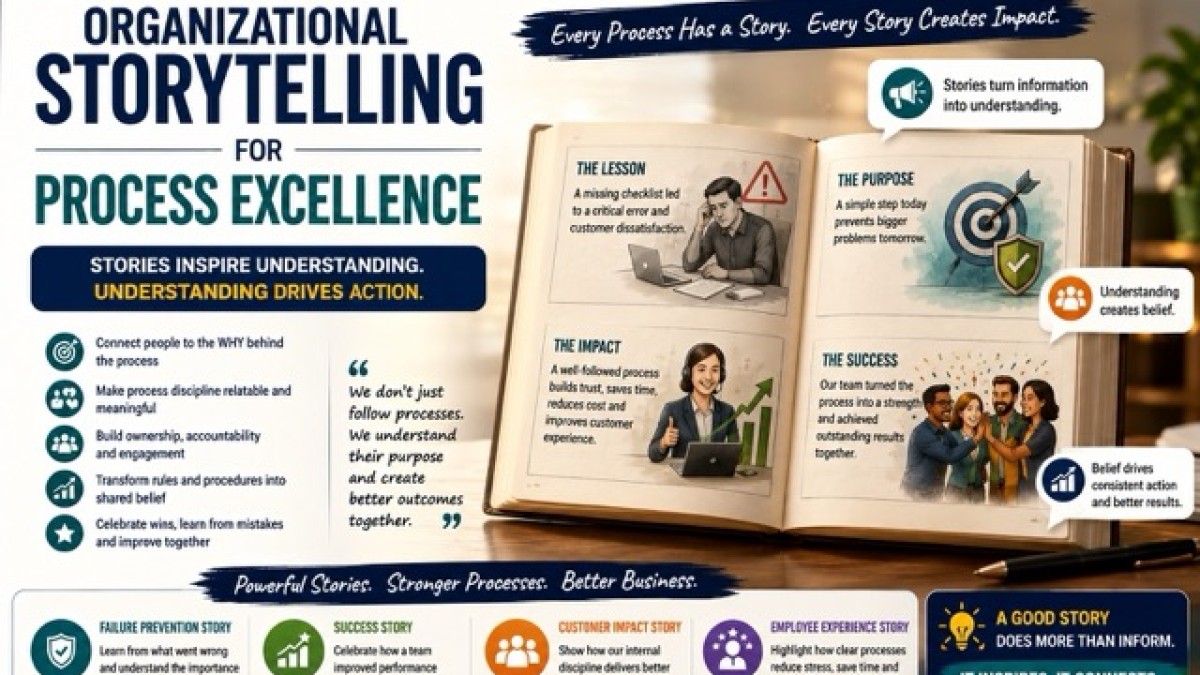
How organizational storytelling turns SOPs and process discipline into meaning using failure, success, and culture stories to build engagement.

Process excellence is often explained through flowcharts, SOPs, KPIs, dashboards, checklists, audit findings, and review meetings. These are important. They bring structure, clarity, consistency, and control. However, organizations often make one serious mistake: they explain process discipline only through documents and instructions, but not through meaning.
People do not follow processes only because a document exists. They follow processes when they understand why the process matters, how it helps them, how it protects the organization, and how it improves customer outcomes. This is where organizational storytelling becomes powerful.
Organizational Storytelling for Process Excellence fits naturally under the people-centered transformation theme in the broader blog series framework, where the focus is on human behavior, leadership, and emotional engagement in change.
Storytelling converts process discipline from a rule-based subject into a relatable business reality. It helps people connect process steps with real consequences, real benefits, real risks, and real success stories. A well-told story can do what a long SOP may not always do: create understanding, attention, ownership, and belief.
Why Processes Need Stories
In many organizations, process communication sounds like this:
- “Follow the SOP.”
- “Update the tracker.”
- “Take approval before proceeding.”
- “Close the deviation report.”
- “Maintain the checklist.”
- “Submit the data before Friday.”
All these instructions may be valid. But to employees, they may sound like additional work, control mechanisms, or management pressure. Unless people understand the reason behind the discipline, they may comply mechanically, partially, or only when someone is watching.
Storytelling changes the message.
Instead of saying, “Update the customer complaint tracker,” a leader can say:
“Last year, we lost an important customer because three complaints were handled by three different people, but nobody had the complete picture. The issue was not lack of effort. The issue was lack of visibility. The complaint tracker is not paperwork. It is our memory system. It helps us see patterns before the customer loses patience.”
This story immediately gives meaning to the process. It explains why documentation matters. It shows how one simple process step can protect customer trust. Stories help people understand that process discipline is not bureaucracy. It is a way to reduce confusion, protect quality, improve speed, build accountability, and prevent repeat mistakes.
Stories Make Process Discipline Human
Processes are usually written in formal language. They define activities, responsibilities, inputs, outputs, records, controls, risks, and escalation points. But actual work happens through people. People face pressure, incomplete information, changing priorities, urgent customer demands, system issues, and interpersonal dependencies.
A story brings this reality into process communication.
For example, consider a purchase order approval process. The SOP may say that all purchase orders above a certain value require approval from the department head and finance. But an employee may feel this slows down work. A story can explain the importance better:
“A project team once placed an urgent order without proper cost approval because the requirement looked unavoidable. Later, finance found that the same material was already available at another site. The company paid twice, storage became a problem, and the project still got delayed because the material specification was not checked. The approval step was not designed to create delay. It was designed to prevent avoidable cost, duplication, and wrong buying.”
This story does not blame anyone. It shows the hidden value of the approval process. It makes the discipline practical. When people see themselves in the story, they understand the process better. They do not feel they are being controlled; they see that the process exists to support better decisions.
Types of Stories That Support Process Excellence
Organizations can use different types of stories to strengthen process discipline.
The first type is the failure prevention story. These stories show what can go wrong when process steps are ignored. They are useful in safety, quality, finance, compliance, procurement, IT security, customer service, and project execution. The objective is not fear. The objective is learning.
The second type is the success story. These stories show how a team improved performance by following or improving a process. For example, a production team may reduce rework by using a pre-dispatch checklist. A sales team may improve conversion by following a structured lead qualification process. A finance team may reduce payment delays by standardizing invoice submission requirements.
The third type is the customer impact story. These stories connect internal process discipline with external customer experience. Employees may not always see how their internal tasks affect the customer. A story can bridge that gap.
The fourth type is the employee experience story. These stories show how process clarity reduces stress, confusion, conflict, and dependency on individuals. For example, an onboarding checklist may look simple, but it prevents new employees from feeling lost.
The fifth type is the culture story. These stories explain what the organization values. For example, a company may share stories about employees who stopped work to correct a safety risk, escalated a quality concern early, or improved a process instead of silently tolerating inefficiency.
Together, these stories build a process-conscious culture.
Storytelling Improves Communication
Process communication often fails because it is too technical, too long, too generic, or too top-down. Employees may attend training sessions, but they may not remember the details. They may read the SOP once, but not internalize its importance.
Stories improve communication because they are easier to understand and remember.
A story has characters, context, challenge, action, and outcome. This structure helps people retain the message. When a leader says, “Please follow the escalation matrix,” the message may be forgotten. But when the leader shares a real example of how delayed escalation caused customer dissatisfaction, financial loss, or operational stress, the message becomes memorable.
Good storytelling also simplifies complex process ideas.
For example, “process variation” may sound technical. But a simple story can explain it:
“Three branches handled the same customer request in three different ways. One completed it in two days, another in seven days, and the third asked the customer for unnecessary documents. The customer did not experience us as one company. They experienced us as three different companies. Process standardization helps us provide a reliable experience.”
This kind of communication makes process excellence understandable to everyone, not only to quality or process teams.
Storytelling Builds Engagement
People engage better when they feel included. Process excellence should not be presented as something created by management and imposed on employees. It should be positioned as a shared journey.
Stories create involvement because employees can contribute their own examples. A process review meeting can begin with questions such as:
- “What is one process that helped you last month?”
- “Where did lack of clarity create rework?”
- “Which customer issue taught us something important?”
- “What mistake did we prevent because someone followed the checklist?”
- “Which process step is not practical and needs redesign?”
These questions invite participation. They convert process discussion from policing to learning.
Engagement increases when people see that their experiences matter. Frontline employees often know where processes fail. They know which forms are confusing, which approvals are delayed, which system fields are duplicated, which handovers are weak, and which controls exist only on paper. When their stories are heard, process improvement becomes more realistic.
Storytelling also supports change adoption. During process change initiatives, people often ask silent questions: Why are we changing? What is wrong with the current way? Will this increase my workload? Will I be blamed for mistakes? Will leadership support us?
Stories can answer these questions better than formal announcements.
A leader can say:
“We are not changing this process because people failed. We are changing it because the business has grown. What worked when we had ten customers will not work when we have two hundred. The new process is our way of preparing for scale.”
This narrative reduces defensiveness and builds readiness.
Stories Help Explain Accountability
Accountability is often misunderstood. Some people see it as blame. Others see it as pressure. In process excellence, accountability means clarity of ownership. It means knowing who does what, by when, with what standard, and with what escalation path.
Storytelling can explain accountability in a positive way.
For example:
“In one project, everyone assumed someone else had confirmed the client specification. Procurement placed the order, stores received the material, and operations discovered the mismatch only during execution. No one had bad intentions. But because ownership was unclear, the entire team suffered. The RACI matrix is not a formality. It prevents work from falling between roles.”
This story explains why role clarity matters. It also avoids blaming individuals. It teaches the organization that accountability protects teams from confusion.
Stories can also highlight positive accountability:
“A junior team member noticed that a checklist item was skipped before dispatch. Instead of ignoring it, she stopped the dispatch and informed her supervisor. The issue was corrected before reaching the customer. That is process ownership.”
Such stories reinforce the behavior the organization wants to see.
Stories Strengthen Culture Building
Culture is not built only through values written on office walls. Culture is built through repeated messages, repeated behaviors, repeated decisions, and repeated recognition.
If leaders repeatedly recognize only speed, people will sacrifice process discipline. If leaders recognize only firefighting, people will not invest in prevention. If leaders praise heroic individual effort but ignore systematic improvement, the culture will remain person-dependent.
Storytelling helps shape culture by making desired behaviors visible.
An organization serious about process excellence should regularly share stories about:
- Teams that reduced rework through standardization.
- Employees who reported risks early.
- Managers who improved handovers between departments.
- Functions that used data to solve recurring problems.
- Departments that simplified unnecessary steps.
- Projects that succeeded because reviews were conducted on time.
- Customer issues that were prevented due to disciplined follow-up.
- These stories show what the organization respects.
Over time, employees start understanding the cultural message: “This company values clarity, prevention, learning, ownership, and improvement.”
That is how process excellence becomes part of daily behavior.
Storytelling and Success Cases
Success cases are especially powerful because they show that process excellence is achievable. Many employees become tired of improvement programs because they see too many presentations and too few visible results. Success stories create confidence.
A strong success case should include four elements.
- First, explain the starting problem. For example, “Invoice processing was taking 15 days because documents were incomplete and approvals were unclear.”
- Second, explain the process intervention. For example, “The team introduced a standard invoice checklist, responsibility matrix, and weekly pending review.”
- Third, show the measurable improvement. For example, “Processing time reduced from 15 days to 7 days, and vendor follow-ups reduced significantly.”
- Fourth, explain the human benefit. For example, “The accounts team faced fewer escalations, vendors received better visibility, and business teams understood submission requirements clearly.”
This makes the success case balanced. It is not just about numbers. It is also about experience, behavior, and learning.
Success stories should be shared in town halls, training sessions, internal newsletters, process review meetings, onboarding programs, and leadership communication. They should be short, practical, and specific.
How Leaders Can Use Storytelling
Leaders play a critical role in organizational storytelling. Employees watch what leaders say, what they repeat, what they ignore, and what they reward.
Leaders can use stories during SOP implementation, change announcements, review meetings, audit closures, training programs, performance discussions, and improvement workshops.
However, leaders must be careful. Stories should not become lectures. They should not be used to shame people. They should not exaggerate facts. They should not convert every mistake into blame.
Effective process stories are honest, respectful, and learning-oriented.
A good leadership story usually follows this structure:
- What happened?
- Why did it matter?
- What did we learn?
- What process behavior should we strengthen?
- 5 How will this help employees, customers, and the organization?
For example:
“We recently had a delayed customer response because the handover between sales and operations was incomplete. The issue was not effort; both teams were working hard. The gap was in the handover discipline. From now on, the handover checklist must be completed before order execution starts. This will reduce confusion, protect delivery timelines, and help both teams work with better confidence.”
This is a mature process narrative. It is practical, fair, and constructive.
Building a Storytelling System
For storytelling to support process excellence, it should not depend only on occasional speeches. Organizations should create a simple storytelling system.
Process teams can collect stories from audits, customer complaints, improvement projects, safety observations, quality reviews, and employee suggestions. HR and communication teams can convert them into short internal stories. Leaders can share them during monthly reviews or town halls. Training teams can include them in SOP training modules.
Each story should have a clear process lesson. For example:
- “Why checklist discipline matters.”
- “Why escalation should happen early.”
- “Why data accuracy protects decisions.”
- “Why handover quality affects customer experience.”
- “Why standardization helps scale.”
- “Why documentation reduces dependency.”
Organizations can also create a “Process Excellence Story of the Month.” This can highlight one team, one improvement, one lesson, and one measurable impact. Recognition can be linked to practical process behavior, not only final results.
This approach gradually makes process excellence visible and emotionally meaningful.
Avoiding Common Mistakes
Storytelling must be used carefully. Some organizations use stories only when something goes wrong. This creates fear. Employees start seeing process discipline as punishment.
The better approach is to balance failure stories with success stories, customer stories, employee stories, and improvement stories.
Another mistake is making stories too long. A process story should be simple and focused. It should not become a detailed case study unless used in formal training.
A third mistake is sharing stories without action. If employees repeatedly share process pain points but leadership does not act, storytelling loses credibility. Listening must lead to improvement.
A fourth mistake is making stories too generic. “We must improve quality” is not a story. A story needs a real situation, a clear problem, and a meaningful lesson.
Conclusion
Organizational storytelling is a powerful but often underused tool for process excellence. Processes tell people what to do. Stories help them understand why it matters.
When stories, examples, success cases, and narratives are used well, employees begin to see process discipline differently. A checklist becomes a risk prevention tool. An approval matrix becomes a decision safeguard. A tracker becomes a visibility system. An SOP becomes a shared way of working. A review meeting becomes a learning forum.
Storytelling improves communication because it makes process messages clear and memorable. It improves engagement because it invites employees to connect their experiences with improvement. It strengthens culture because it repeatedly reinforces the behaviors the organization wants to build.
In the end, process excellence is not achieved by documents alone. It is achieved when people believe in disciplined ways of working and practice them consistently. Stories create that belief. They give life to processes, meaning to discipline, and direction to culture.
Categories: : Storytelling