Nudge Theory & Behavioural Economics in Change Programs
 ACTSol and Associates
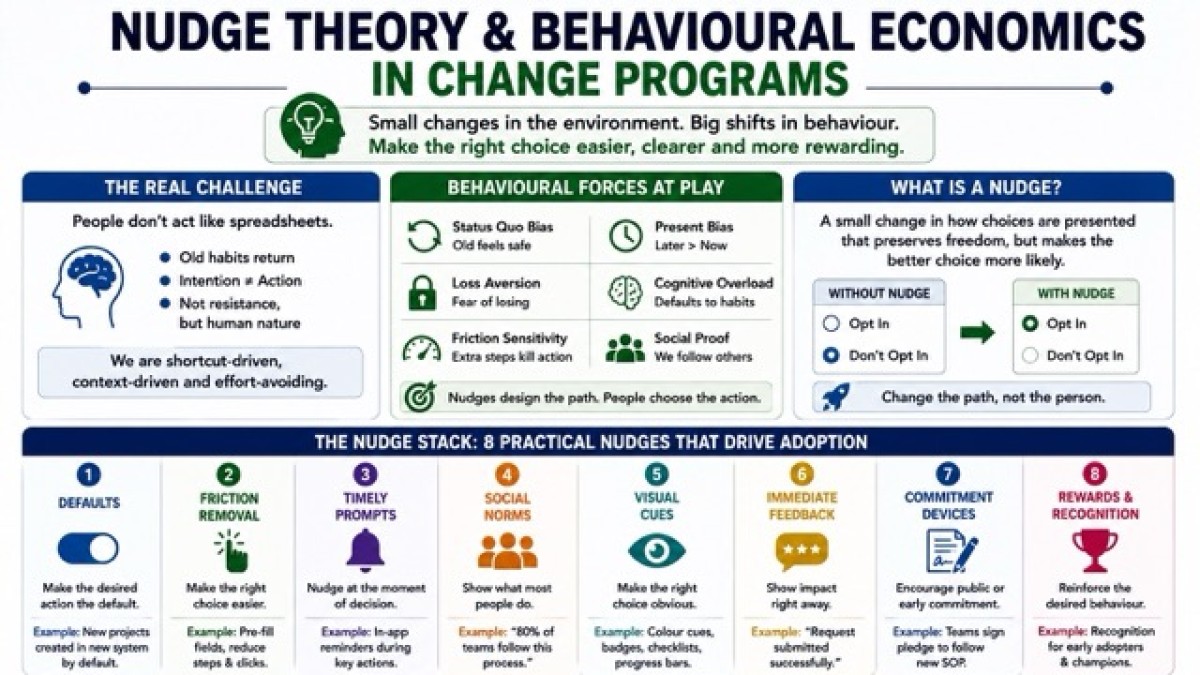
Use nudge theory and behavioural economics to make the right change behaviour easier.

Most change programs fail in a predictable way. They assume people will act like spreadsheets.
You communicate the new process. You train. You launch. You publish the SOP. You even add a dashboard. Then… the old habits come back the moment nobody is watching.
Not because employees are "resistant". Because human beings do not make decisions the way change plans assume they do.
Behavioural economics starts with one uncomfortable truth:
We are not consistently rational, and we are definitely not consistently disciplined.
We are shortcut-driven, context-driven, and effort-avoiding; especially when we're busy, under pressure, and juggling ten priorities. That's where nudges become powerful in change programs.
Not as manipulation. Not as "clever tricks".
But as choice design; small, practical adjustments to the environment that make the desired behaviour easier, more obvious, timelier, and more socially normal. And the best part? A good nudge improves adoption without heavy-handed enforcement or policing.
The behavioural problem change leaders keep ignoring
Most organisations try to drive adoption using three levers:
- Information (emails, presentations, town halls)
- Instruction (training, manuals, SOPs)
- Inspection (audits, escalation, compliance checks)
These levers have their place. But they don't solve the real gap. The real gap is intention vs action.
People often agree with the change. They may even "support" it. And still not do it. Why?
Because every day work is a battlefield of behavioural forces:
- a) Status quo bias: old ways feel safer and familiar
- b) Present bias: "I'll do it later" wins over "it's better long-term"
- c) Loss aversion: the fear of losing competence/status is stronger than the promise of gains
- d) Cognitive overload: when the brain is full, it defaults to habits
- e) Friction sensitivity: even small extra steps kill adoption
- f) Social proof: people follow what others actually do, not what leaders say
Change programs that don't design for these forces end up relying on policing. And policing doesn't scale.
What is a "nudge" in plain language?
A nudge is a small change in the way choices are presented that:
- a) Preserves freedom of choice (no forced mandate), but
- b) Makes a better choice more likely
Think of it as choice architecture.
You're not changing the person. You're changing the path.
A classic example is a default option.
If the default on a form is "Yes, enrol me", most people stay enrolled. If the default is "No", most people never enrol; not because they made a strong decision, but because they went with the easiest path.
That's not laziness. That's how humans are built.
In organisations, nudges are the same idea, applied to tools, workflows, systems, communication, and daily routines.
Why nudges work so well in change programs.
Because adoption is rarely a "big decision". It's a thousand small moments.
- a) Will I log into the new tool today?
- b) Will I fill the new field or skip it?
- c) Will I follow the new checklist or "do it my way"?
- d) Will I raise a ticket properly or message someone informally?
- e) Will I document the learning or keep it in my head?
Each moment is shaped by micro-forces:
- a) Effort
- b) Visibility
- c) Timing
- d) Emotion
- e) Norms
- f) Confidence
- g) Immediate payoff
Nudges target those micro-forces. They make the right behaviour:
- a) Easier
- b) Sooner
- c) Clearer
- d) More rewarding
- e) More "what people like us do here"
That's how habits form.
The Nudge Stack: 8 practical nudge types that drive adoption.
If you want nudges that actually work in organisations, stop thinking "motivational".
Start thinking "mechanical". Here are 8 nudge types that reliably move behaviour; especially during change.
1) Defaults (make the desired action the path of least resistance). Defaults are behavioural gravity.
Examples in change programs
- a) New tool adoption: New projects are created by default in the new system; old system requires a special request.
- b) New SOP compliance: The workflow template in the project tool automatically includes the SOP checklist; people must remove it deliberately.
- c) Cybersecurity: Multi-factor authentication is enabled by default for new accounts; opting out requires approval.
Why it works: people stick with defaults when they're busy, unsure, or overloaded—which is exactly what change creates.
2) Friction removal (make the right behaviour easier than the wrong one). Most "resistance" is just friction. Remove friction and adoption jumps.
Examples
- a) Expense policy change: Pre-fill vendor details, GST fields, and cost centres; reduce clicks from 12 to 4.
- b) New CRM process: Add SSO login + auto-sync contacts + one-click meeting logging.
- c) Incident reporting in operations: QR code at the site links directly to a 30-second reporting form, with auto location/time captured.
Why it works: behaviour follows effort. If the new way feels heavier, people won't "transform"—they'll bypass.
3) Timely prompts (nudge at the moment of action, not in an email). Most organisations prompt too early. They send long emails on Monday about behaviour needed on Friday. By then, the brain has moved on.
Examples
- a) New procurement rule: When someone raises a PR above a threshold, the system prompts: "Attach 3 comparative quotes (template available)."
- b) Safety behaviour: When a maintenance ticket is opened, the app displays a quick "PPE + LOTO reminder" before the job begins.
- c) Timesheet discipline: A gentle prompt pops up at 4:30 pm: "You're 80% done,finish now in 2 minutes."
Why it works: nudges are strongest when they hit the "choice moment".
4) Salience and simplification (make the right action obvious). People don't ignore important things. They ignore unclear things.
Examples
- a) Replace a 9-step instruction with a one-screen checklist at the point of use.
- b) Use pre-written templates (emails, checklists, meeting notes) so "doing the new thing" starts from 80% done.
- c) Rename confusing options in a system so the right selection is unmistakable (language matters).
Why it works: clarity reduces hesitation. Hesitation creates delay. Delay recreates old habits.
5) Social norms (make adoption feel normal, not heroic). Humans copy humans. Especially in uncertainty.
Examples
- a) Adoption dashboard by team (not individuals): "Team A: 92% usage, Team B: 67%."
- b) Peer stories: short internal posts: "How I saved 30 minutes using the new workflow."
- c) Visible signals: "This team runs meetings only through the new agenda template."
Important: don't shame. Don't name-and-blame. Norms work best when they feel aspirational, not punitive.
Why it works: people don't want to be the odd one out.
6) Feedback loops (show progress and payoff quickly). Change often fails because payoff is delayed. But humans respond to immediate feedback.
Examples
- a) After submitting a request correctly: "Done. Average approval time drops from 5 days to 2.4 days when forms are complete."
- b) Usage milestone: "You've completed your first 5 workflows; next step: automate approvals."
- c) Managers get a weekly digest: "Top 3 adoption wins + 2 bottlenecks to remove."
Why it works: feedback converts effort into meaning.
7) Commitment devices (turn "I should" into "I will"). Commitment is a bridge between intention and action; especially if it's specific.
Examples
- a) Team huddle ends with: "In the next 7 days, we will log every customer interaction in CRM—no exceptions."
- b) People choose their own adoption goal: "I'll complete 10 transactions in the new system this week."
- c) A calendar block is created for the habit: "Daily 10-minute documentation block."
Why it works: commitments reduce ambiguity and create personal ownership without policing.
8) Recognition and micro-rewards (reward the behaviour you want repeated). Not big bonuses. Not gimmicks. Small recognition; timely and specific.
Examples
- a) "Best adoption move of the week" posted in the team channel with a concrete behaviour highlighted.
- b) Badges tied to meaningful actions (e.g., "First project fully executed through the new workflow").
- c) Leader thank-you notes for behaviours that reduce risk (e.g., correct incident reporting).
Why it works: recognition builds identity. "this is how we work".
Practical nudges that improve adoption without enforcement:
Let's get even more concrete. Here are common change scenarios and nudges that work without turning managers into police.
Scenario A: New digital tool adoption (ERP / CRM / Workflow app)
Common failure mode: People "try" the tool, then return to Excel / WhatsApp because it's faster.
Nudges that work
- a) Default: new work requests can only be initiated through the new tool; email requests get an auto-reply with the link.
- b) Friction removal: single sign-on + pre-filled fields + saved favourites.
- c) Prompt: when someone completes a related task in email, a plugin says: "Log this in CRM in one click."
- d) Social norm: team-level usage scoreboard with "most improved team".
- e) Feedback: "You saved 18 minutes this week through auto-fill and templates."
Result: adoption rises because the tool becomes the easiest path, not the "expected path".
Scenario B: SOP compliance (without turning it into audit terror)
Common failure mode: SOP is treated as a document, not a workflow.
Nudges that work
- a) Embed the SOP into tools: checklist appears inside the task, not in a PDF.
- b) Default templates: project kick-off automatically creates the SOP-aligned task list.
- c) Reduce friction: one-click access to forms, registers, and evidence attachments.
- d) Salience: "Quality gate" steps highlighted as mandatory fields (not optional text).
- e) Feedback: "Rework reduced by 22% in projects using the checklist."
Result: compliance becomes "how work flows" rather than "what auditors want".
Scenario C: Safety behaviour (PPE, incident reporting, emergency actions)
Common failure mode: Safety slips when workload increases.
Nudges that work
- a) Visual cue + placement: PPE placed at the exact point of entry, not somewhere behind.
- b) QR reporting: 30-second incident report via QR + auto-tagging location/time.
- c) Prompt at the moment of risk: before equipment maintenance ticket starts: "Confirm isolation checklist."
- d) Recognition: highlight "near-miss reporting wins" weekly, not only major incidents.
Result: safety becomes a habit loop, not a lecture.
Scenario D: Reducing bypass behaviour (shadow processes)
Common failure mode: People route around the new process because the old way is "faster".
Nudges that work
- a) Make bypass slightly harder: old method requires extra steps or a manual approval note.
- b) Make the desired method smoother: auto, routing, pre, filled fields, fewer clicks.
- c) Immediate payoff: faster turnaround for correctly submitted requests (this is a behavioural incentive, not policing).
- d) Norm message: "90% of requests are now submitted through the portal, join the standard flow."
Result: bypass declines because it stops being the easy option.
How to design nudges systematically (not randomly).
Nudges fail when they're treated as "ideas". Nudges succeed when they're treated as behaviour engineering.
Use this 7-step design method:
Step 1: Define the exact behaviour (not the slogan)
Bad: "Adopt the new system."
Good: "Create every new customer opportunity in CRM within 24 hours."
Step 2: Identify the critical moments. Where does the decision actually occur?
- a) Before a meeting
- b) At ticket creation
- c) When approving
- d) During handover
- e) At the end of the day
Step 3: Diagnose the behavioural barrier Is it:
- a) Friction?
- b) Forgetting?
- c) Fear of looking incompetent?
- d) Unclear benefits? •low confidence?
- e) Social norms pulling the other way?
Step 4: Choose 1–2 nudge types only. Over-nudging becomes noise. Pick the smallest change with the biggest leverage.
Step 5: Prototype in days, not months. Mock the prompt. Pilot the default. Test the template.
Step 6: Measure behaviour, not sentiment. Don't ask "Do you like it?" Track:
- a) First-time use
- b) Repeat use
- c) Completion rate
- d) Error rate
- e) Time, to, complete
- f) Help requests
- g) Rework reduction
Step 7: Scale with governance. Create a small nudge library and reuse patterns across processes. That's how nudges become a capability; not a one-off trick.
Ethical nudging: how to avoid manipulation (and backlash).
If people feel nudged for the organisation and not for the work, trust erodes. So, use simple ethical guardrails:
- a) Transparency: people should be able to see what's happening (no dark patterns).
- b) Freedom: opting out should exist (unless it's a true safety / legal requirement).
- c) Benefit: the nudge should improve work quality, safety, speed, or clarity, not just control.
- d) Fairness: nudges shouldn't disadvantage specific groups (e.g., those with limited access / ability).
- e) Privacy respect: avoid nudges built on intrusive monitoring.
A useful test is this: Would you be comfortable explaining the nudge to employees in one sentence? If not, redesign it.
The hidden villain: "sludge" that kills change adoption
Sludge is the opposite of nudge.
It's unnecessary friction.
- a) Extra approvals
- b) Duplicate data entry
- c) Unclear forms
- d) Long templates nobody uses
- e) Mandatory steps with no purpose
Many change programs accidentally introduce sludge while trying to control behaviour.
Then they wonder why adoption is low. If you want high adoption without policing, do a sludge audit:
- a) What steps can we delete?
- b) What can be pre-filled?
- c) What can be automated?
- d) What can be moved into the workflow instead of a document?
- e) What can be made default?
Often, removing sludge delivers more adoption than adding training.
A simple "Nudge Playbook" for change leaders.
If you want to operationalise this in your change program, run it like a sprint:
- Pick 3 critical behaviours that define success
- Map the real journey (where people actually struggle)
- Design 6–10 nudges across the Nudge Stack
- Pilot with one team for 2–3 weeks
- Measure behaviour outcomes
- Scale the nudges, not just the communication
- Create a reusable nudge library for future programs
This is how you stop begging for adoption. You engineer it.
Closing insight: stop trying to "convince" humans; design for humans
Change leaders love big moves.
Big launches. Big town halls. Big training calendars. But daily behaviour is shaped by small things:
- a) What's easiest
- b) What's default
- c) What's visible
- d) What's rewarded
- e) What others do
- f) What happens in the moment of choice
Nudge Theory and behavioural economics don't replace change management. They make it real.
They turn adoption from a motivational problem into a design problem. And design problems are solvable; without policing.
If you want the fastest improvement in adoption in your next change program, don't start with another communication deck.
Start with one question: What is the smallest change we can make to the environment so the right behaviour happens naturally?
That's nudging. That's behavioural change. That's how you make change stick.
Categories: : Change Impact