Leading Change When You Are Not the CEO
 ACTSol and Associates
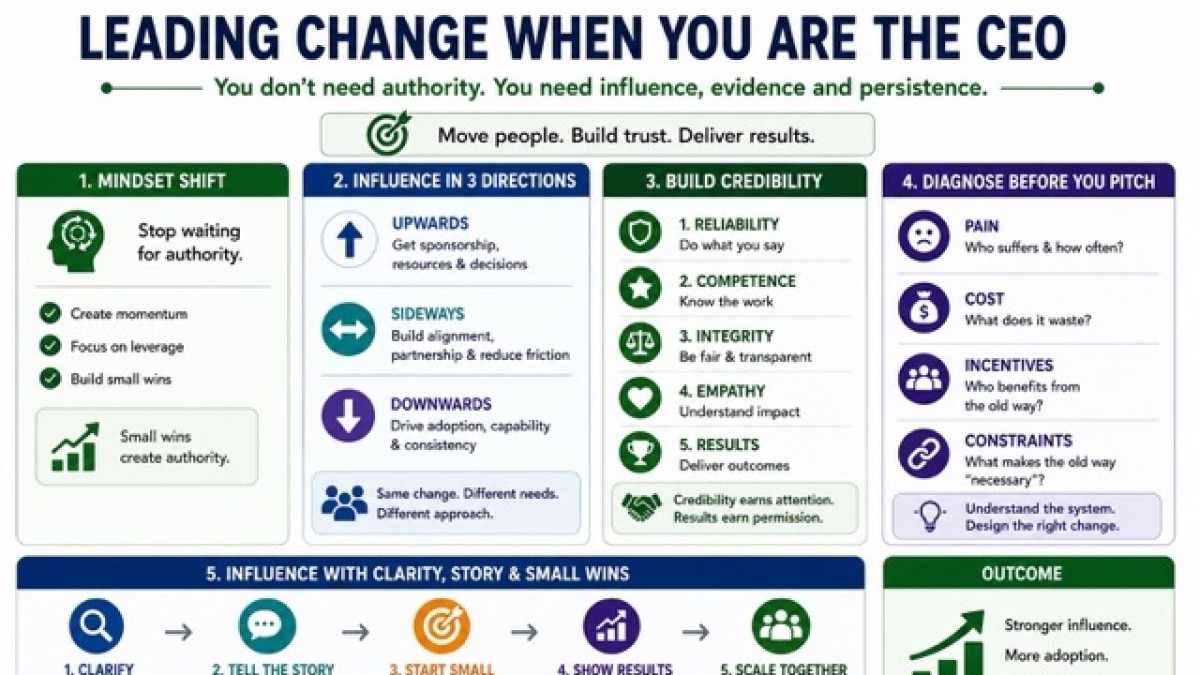
Lead change without a corner office—clarity, credibility, and a plan that respects reality.

You don't need a corner office to move an organization. You need clarity, credibility, and a plan that respects reality.
Most change fails for a simple reason: people assume authority equals influence. It doesn't. Authority can force compliance for a while. Influence earns adoption; especially when the change is inconvenient, ambiguous, or politically messy.
If you're a middle manager, a project lead, a team supervisor, a subject-matter expert, a product owner, a plant engineer, a frontline champion, or an "unofficial glue person" everyone listens to, this is your playing field.
Because here's the truth: most change is actually executed by people who are not the CEO.
The CEO may approve. Sponsors may announce. Consultants may design. But the change becomes real only when teams alter habits; how they work, what they prioritize, what they tolerate, what they measure, and what they repeat.
So, the question is not, "How do I lead change without authority?" The better question is: "How do I make the new way feel safer, smarter, and more worthwhile than the old way?"
This article gives you a practical playbook; how to influence upwards, sideways, and downwards using credibility, storytelling, and small wins, with examples you can copy.
1) Start by dropping the "I don't have authority" story
It's understandable. It's also limiting.
When you say, "I don't have authority," you unconsciously do three things:
- a) You wait for permission instead of creating momentum.
- b) You focus on constraints instead of leverage.
- c) You treat change as a single big decision instead of a sequence of small shifts.
The fastest way to lead without authority is to stop chasing the big "Yes" and start building undeniable evidence.
Not evidence in PowerPoint. Evidence in outcomes.
Small wins are a form of authority. They create legitimacy. They reduce perceived risk. They make senior leaders comfortable backing what already looks successful.
Think of influence like this:
- a) Credibility earns attention.
- b) Storytelling earns belief.
- c) Small wins earn permission.
2) Understand the three directions of influence.
When you're not the CEO, you're typically influencing in three directions at once:
Upwards (to leaders): You need sponsorship, air cover, resources, decisions, and protection from politics.
Sideways (to peers and other departments): You need cooperation, alignment, shared handoffs, and reduced friction.
Downwards (to your team / frontline): You need adoption, capability, consistency, and resilience when people resist.
Most change leaders fail because they try to push the same message in all three directions. That never works.
Leaders want risk control. Peers want fairness and reciprocity. Teams want clarity and support.
Same change. Different psychology.
3) Build credibility before you ask for change:
Credibility is not your designation. It's your reputation for being useful and reliable.
A simple credibility stack (in priority order):
- Reliability: You do what you said you'd do.
- Competence: You understand the work, not just the theory.
- Integrity: You don't play games with data or blame.
- Empathy: You understand what the change will cost people.
- Results: You can point to outcomes, not intentions.
A credibility move you can start today. Create a "trust trail" for your change:
- a) One-page summary of the problem (facts, not opinions)
- b) Two examples of real impact (missed SLA, rework, customer escalation, safety near-miss, cost leakage)
- c) A small pilot idea with low risk
- d) Clear ownership and measurement
When you consistently show up with clarity and follow-through, people start saying: "Let's hear them out. They've thought this through."
That's influence.
4) Don't sell the change. Diagnose what's really happening.
Middle managers often make one fatal mistake: they promote solutions before they understand the system.
Before you pitch anything, diagnose four things:
A) The pain (who suffers, and how often?). Is it a daily irritation or a quarterly crisis?
B) The cost (what does the current way actually waste?). Time, money, reputation, morale, safety, compliance; pick the real one.
C) The incentives (who benefits from the old way?). Some people are rewarded for the problem continuing.
D) The constraints (what makes the old way "necessary"?). Tech limitations, unclear policy, staffing, procurement cycles, approvals. Your job is not to call people resistant.
Your job is to find the rational reasons the old behaviour survives.
Example: "We need CRM adoption"
Surface level problem: Sales isn't updating CRM.
Real diagnostic findings:
- a) CRM fields don't match sales workflow.
- b) Updates take 15 minutes per deal, daily.
- c) Managers use WhatsApp updates anyway.
- d) Reps get punished for transparency ("Why is this stuck?"), so they hide data.
If you push "discipline," you lose credibility. If you redesign the workflow and incentives, you create adoption.
5) Influence upwards: make it easy for leaders to say yes
Senior leaders are not rejecting your idea because it's bad.
They're rejecting it because it feels risky, political, expensive, or distracting. So, speak the language of leadership:
- a) Risk
- b) Trade-offs
- c) Cost of delay
- d) Decision clarity
- e) Reputation and compliance exposure
- f) Capacity
The upward influence tool: the Permission-to-Pilot pitch
Instead of asking for a big approval, ask for a bounded experiment.
Your ask should sound like this:
- a) "Let's run a 2-week pilot with one team."
- b) "No new headcount."
- c) "One metric: cycle time / rework / complaint rate."
- d) "If it doesn't improve by X%, we stop."
- e) "If it improves, we bring you a decision memo with options."
That removes fear. Leaders love controlled bets.
Example: Procurement change without authority
You notice maverick purchasing causing cost leaks. You're not the Head of Procurement.
Bad ask: "We need a new procurement policy."
Smart ask: "Can I pilot a '3-quote + rate contract' approach for just the top 10 recurring items in my project for 30 days? I'll report savings, vendor performance, and exceptions weekly. If we don't save at least 5–8% without delays, we drop it."
Now you're not proposing bureaucracy. You're proposing proof.
A simple upward script you can reuse
"I'm not asking for a full-scale rollout. I'm asking for permission to test a low-risk pilot that reduces (specific risk / cost). I'll bring back data and a recommendation. If it doesn't work, we stop."
Add one more powerful element: pre-wire the conversation
Before the formal meeting, do three short 10-minute chats:
- a) One with the leader's trusted aide / COO / PMO
- b) One with a respected peer who will support you in the room
- c) One with a person who will be impacted (so you can say "We involved them")
When the leader hears agreement echoes, it stops feeling like "your idea" and starts feeling like "our direction."
6) Influence sideways: trade value
Peers and other departments don't resist because they dislike you. They resist because they fear:
- a) Extra work,
- b) Loss of control,
- c) Blame,
- d) Uneven accountability,
- e) Or a "hidden agenda."
So, stop trying to "convince" peers.
Start building exchanges. Sideways influence is built on three currencies
- Help: "I'll reduce your workload if you support this."
- Reputation: "This will make your team look good."
- Protection: "This will reduce escalations and blame risk."
Example: Improving handoffs between Sales and Operations
You want cleaner handover documents. Ops complains Sales sends junk. Sales complains Ops delays delivery.
If you call a meeting and say, "Sales must improve," you lose Sales instantly. Instead, propose a trade:
- a) Ops defines the minimum viable handover checklist (5 fields).
- b) Sales agrees to comply if Ops commits to a 24-hour confirmation SLA.
- c) You build a shared dashboard: "handover completeness" and "confirmation time."
Now both teams get something. That's sideways influence.
Create a "coalition of the willing". You don't need everyone.
You need 2–3 respected people across functions who will:
- a) Trial the new behaviour,
- a) Endorse it publicly,
- b) And share outcomes.
Informal leaders are the real accelerators.
7) Influence downwards: lead adoption, not obedience
Your team will not adopt change because it's logical. They'll adopt it because it feels:
- a) Clear,
- b) Supported,
- c) Fair,
- d) And survivable.
Downwards influence requires four non-negotiables
- Clarity: "What exactly changes Monday morning?"
- Capability: "Do we know how to do it?"
- Capacity: "Do we have time, tools, templates?"
- Consequences: "What happens if we don't?"
If you skip any of these, you create silent sabotage.
Example: Safety behaviour change on a site. You're a site manager, not the CEO. You want PPE compliance and near-miss reporting.
If you shout, "Safety first," nothing changes. What changes behaviour:
- a) Daily 5-minute toolbox talk with one real incident story,
- b) Visible "near-miss board" and recognition for reporting,
- c) Simple QR form for logging,
- d) Supervisors trained to respond without blaming,
- e) One small win: "Near misses up, injuries down."
That's real leadership.
8) Use storytelling to make the change feel real
Data informs. Stories move.
When you don't have authority, storytelling is your multiplier because it makes the change emotionally coherent. A useful structure for change stories:
The 5-part story
- The normal: what people currently do
- The friction: what goes wrong (specific, relatable)
- The cost: what it leads to (customer pain, rework, risk)
- The turning point: what we tried differently
- The new normal: what life looks like after adoption
Example: Service quality change
Instead of: "We must follow the new call script."
Tell this:
- a) "Last week, a customer called about a lease closure delay."
- b) "We transferred them three times."
- c) "They posted on LinkedIn and tagged us."
- d) "One person followed a simple two-step ownership rule, and the issue closed in 6 hours."
- e) "If we repeat that, we stop losing trust one call at a time."
Now your change is not "a process." It's a reputation shield.
9) Engineer small wins like a professional.
A small win has five characteristics:
- Visible: people can see it happened
- Meaningful: it reduces a real pain
- Fast: days or weeks, not quarters
- Repeatable: not dependent on one hero
- Measurable: even with simple metrics
Small win ideas that work in real organizations
- a) Reduce approval cycle time for one document type
- b) Cut rework by fixing one recurring defect source
- c) Standardize one template that removes confusion
- d) Automate one manual report that wastes hours
- e) Pilot a new meeting cadence with clear outcomes
- f) Fix one handoff between two teams with a checklist + SLA
Example: Process improvement without authority in Finance
Problem: Expense reimbursements take 21 days. Employees are angry. Finance is blamed.
You can't change the entire policy. But you can:
- a) Map the top 3 delay causes,
- b) Remove one bottleneck (missing documents) with a better claim checklist,
- c) Pilot "claims clinic" twice a week for 30 minutes,
- d) Publish weekly turnaround time.
If it drops to 10–12 days, you've created momentum.
Now you can ask for bigger fixes.
10) Know what resistance actually is; and respond correctly
Resistance is rarely a personality problem.
It is usually one of these:
- a) Loss: "I'm losing status, comfort, expertise, control."
- b) Fear: "I'll look incompetent."
- c) Fatigue: "We've done too many initiatives."
- d) Distrust: "Leaders will blame us when it fails."
- e) Misalignment: "This conflicts with how I'm measured."
If you treat all resistance as stubbornness, you create enemies. If you treat it as information, you become a strategist.
Practical resistance moves
- a) Name the cost honestly: "This adds 10 minutes per case initially."
- b) Remove shame: "Learning time is expected."
- c) Make it safe to try: "We'll review errors weekly without blame."
- d) Protect people: "Escalations come to me first."
- e) Align measures: "We'll adjust KPIs so this doesn't punish you."
This is how you lead change downwards and sideways without authority, by lowering the threat level.
11) Your "no-CEO" change playbook in 7 steps
Here's a sequence that works in real life:
Step 1: Choose a change worth your political capital. Pick something tied to a real pain and aligned with business goals.
Step 2: Diagnose the system. Find causes, incentives, constraints, and who benefits from the status quo.
Step 3: Build credibility with a trust trail. One-page, factual, small pilot plan, ownership, measures.
Step 4: Pre-wire stakeholders. Short chats before big meetings. Reduce surprise.
Step 5: Tell the story. Make it human. Make it concrete. Make it about outcomes.
Step 6: Run a pilot and harvest small wins. Visible, fast, repeatable, measurable.
Step 7: Scale with a coalition. Convert results into sponsorship, resources, and standardization.
This sequence turns influence into traction.
Organizations are social systems. Politics is not optional. When politics shows up, don't moralize it. Navigate it.
Three rules that keep you safe
- Never embarrass someone publicly.
- Share credit wider than necessary.
- Frame your change as protecting reputations and reducing risk.
If you do those three, even opponents will soften.
Example: A senior leader blocks you
You want a new approval workflow. One senior person sees it as a threat.
Instead of fighting, reframe:
- a) "This reduces escalations landing on your desk."
- b) "This makes decisions auditable."
- c) "This gives you visibility without micromanaging."
You're not taking control away. You're giving control in a cleaner form.
13) Practical checklists you can use tomorrow
Credibility checklist (quick self-audit)
- a) Do I consistently deliver what I promise?
- b) Do I understand frontline realities?
- c) Do I speak with fairness and integrity?
- d) Do people come to me for clarity?
- e) Can I show one measurable improvement I led?
Upwards influence checklist
- a) Is my ask small, bounded, and low risk?
- b) Did I quantify cost of delay?
- c) Did I provide options, not a single demand?
- d) Did I pre-wire key influencers?
- e) Did I make it easy for the leader to sponsor publicly?
Sideways influence checklist
- a) Who loses effort / status if this happens?
- b) What value can I trade to make it fair?
- c) What shared metric will reduce blame?
- d) Who are 2–3 coalition members I can recruit?
Downwards adoption checklist
- a) What changes Monday morning (specific behaviours)?
- b) What training / templates / tools are needed?
- c) How will I protect the team during the learning curve?
- d) How will we recognize early adopters?
- e) What will we stop doing to create capacity?
Closing: The quiet power of leading without authority
Leading change when you are not the CEO is not a disadvantage. It's a skill.
It forces you to do the real work: earning trust, shaping meaning, and proving value through action.
When you can influence upwards with risk-controlled pilots, sideways through value trades and coalitions, and downwards through clarity and support; you become the kind of leader organizations quietly depend on.
Not because you can command. Because you can move people. And that is the highest form of change leadership.
Categories: : Leadership