Hybrid Workflows for Hybrid Workplaces
 ACTSol and Associates
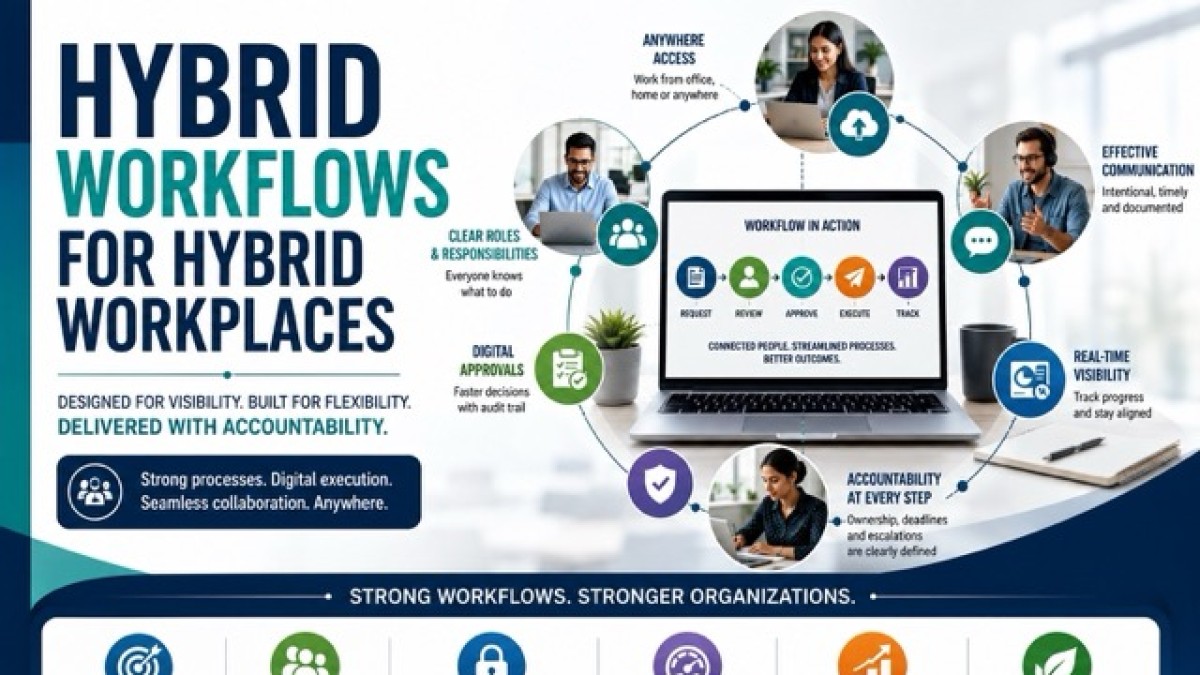
How to redesign approvals, communication, documentation, accountability, and governance so hybrid workplaces run on clear hybrid workflows.

Hybrid work is no longer a temporary adjustment. For many organizations, it has become a permanent operating model. Employees may work from offices, homes, client locations, plants, branches, co-working spaces, or even different cities and countries. Teams may meet physically once a week, once a month, or sometimes not at all. Managers may supervise people they rarely see in person. Customers may expect faster service even when internal teams are spread across locations.
This creates a new challenge for process excellence. Traditional processes were often designed for office-based work. Approvals happened by walking to a manager’s cabin. Documents were physically signed. Clarifications were taken during informal discussions. Supervisors could visually monitor work. Teams depended heavily on proximity, personal follow-up, and verbal communication
In a hybrid workplace, these assumptions no longer work. Processes must be redesigned for visibility, clarity, accountability, and digital execution. “Hybrid Workflows for Hybrid Workplaces” rightly belongs to the future-of-work theme in the broader process and change management blog series.
The real question is not whether people work from office or home. The real question is whether the organization’s workflows are strong enough to function smoothly when people are not physically together.
Why Hybrid Work Needs Hybrid Workflows
Hybrid work becomes successful only when work is not dependent on location. A process should not stop because the approving authority is travelling. A customer query should not remain unanswered because the responsible person is working remotely. A purchase request should not be delayed because supporting documents are saved on someone’s desktop. A project update should not depend only on a meeting.
Hybrid workflows are processes designed to work across physical and digital environments. They combine structured process steps, digital tools, clear ownership, defined approvals, documented communication, and governance mechanisms. They allow work to move forward even when people are not sitting in the same office.
A good hybrid workflow answers six basic questions:
- Who has to do what?
- Where will the work be recorded?
- How will approvals happen?
- How will people communicate?
- How will progress be tracked?
- Who is accountable if something is delayed?
Without these answers, hybrid work can quickly become confusing. Employees may work hard, but the organization may still suffer from delays, duplication, missed handovers, poor documentation, and weak accountability.
From Person-Dependent Work to Process-Driven Work
In many organizations, work gets done because certain people know what to do. They remember the steps, know whom to call, and understand informal approval routes. This may work in a physical workplace, but it becomes risky in hybrid and distributed teams.
Hybrid work requires a shift from person-dependent execution to process-driven execution. This does not mean removing human judgment. It means ensuring that work does not collapse when people are unavailable, remote, or working asynchronously.
For example, in a traditional office, a sales team may verbally inform finance about a special discount approval. In a hybrid setup, this can create confusion. Finance may not have a formal record. The approving authority may not remember the discussion. The customer commitment may differ from the approved terms. A hybrid workflow would require the discount request to be raised in a defined system or template, approved digitally, recorded properly, and visible to all concerned functions.
This is process discipline adapted to modern work.
Redesigning Approvals for Speed and Control
Approvals are one of the biggest pain points in hybrid workplaces. In physical offices, approval delays are often managed through personal follow-up. In hybrid teams, that approach becomes unreliable.
Organizations must redesign approval workflows with clear rules. Every approval process should define:
- What needs approval
- Who can approve
- What documents are required
- What limits apply
- What is the expected turnaround time
- What happens if the approver is unavailable
- How escalation will happen
For example, procurement approvals can be structured by value limits. Low-value purchases may be approved by department heads. Medium-value purchases may need finance review. High-value purchases may require senior management approval. Emergency purchases may follow a fast-track route, but with post-facto documentation.
Digital approval tools can make this easier. Workflow systems, ERP modules, shared forms, email approval trails, e-signature platforms, and collaboration tools can reduce dependency on physical signatures. However, technology alone is not enough. Approval logic must be well-defined before it is automated.
A poor manual approval process becomes a poor digital approval process if the rules are unclear.
Communication Must Become Intentional
Hybrid work exposes weak communication habits. In an office, people often compensate for unclear processes through informal conversations. In a distributed setup, this becomes difficult. People may miss updates, misunderstand priorities, or assume that someone else is handling the task.
Communication in hybrid workflows must be intentional, structured, and traceable.
There are three types of communication that every hybrid process should define. First, operational communication: daily updates, task status, clarifications, and handovers. Second, decision communication: approvals, exceptions, deviations, and management decisions. Third, governance communication: review meetings, performance updates, audit observations, and improvement actions.
Each type of communication should have the right channel. Quick clarifications may happen through chat. Formal decisions should be recorded through email, workflow tools, or meeting minutes. Project progress may be tracked through dashboards. Process changes should be communicated through circulars, SOP updates, or training sessions.
The mistake many organizations make is using one tool for everything. Chat tools are useful, but they are not always suitable for formal approvals. Emails are useful, but they can become difficult to track. Meetings are useful, but they should not become the only place where decisions are known.
Hybrid communication should reduce confusion, not increase noise.
Documentation Becomes the Backbone
H3) Documentation Becomes the Backbone In hybrid workplaces, documentation is not a bureaucratic requirement. It is the backbone of continuity.
When people work from different locations, documents must be easy to find, easy to understand, and properly controlled. This includes SOPs, checklists, templates, approval records, meeting minutes, project plans, trackers, audit reports, customer commitments, vendor documents, and compliance records.
Poor documentation creates several risks. Employees may use outdated formats. Teams may store files in personal folders. Managers may not know the latest status. New employees may struggle to understand the process. Audits may become difficult. Disputes may arise because there is no reliable record.
A hybrid workflow needs strong document management. Organizations should define where documents are stored, who can access them, who can edit them, how versions are controlled, and how long records must be retained.
For example, an SOP should not be shared casually as multiple Word files over email. There should be one controlled version. If the process changes, the SOP should be updated, approved, and communicated. Employees should know where to find the latest version.
Documentation is not about creating paperwork. It is about creating organizational memory.
Accountability Must Be Visible
One of the common concerns about hybrid work is accountability. Managers may feel that they cannot monitor work when employees are not physically present. Employees may feel that expectations are unclear. Teams may blame each other when work is delayed.
The solution is not excessive surveillance. The solution is visible accountability.
Every hybrid workflow should clearly define roles and responsibilities. A RACI matrix can be very useful. It identifies who is Responsible, who is Accountable, who must be Consulted, and who must be Informed.
For example, in a customer complaint process, the customer service executive may be responsible for logging the complaint. The quality team may be responsible for investigation. The operations head may be accountable for corrective action. Sales may be consulted for customer communication. Senior management may be informed in high-risk cases.
When roles are clear, follow-up becomes easier. Review discussions become fact-based. Delays can be identified without blaming people unnecessarily.
Accountability should also be supported by measurable indicators. These may include turnaround time, pending tasks, overdue approvals, error rates, rework, audit findings, customer response time, and closure status. Dashboards can help teams see what is moving, what is stuck, and what needs attention.
Hybrid accountability must be based on outcomes, not physical presence.
Collaboration Tools Must Support the Process
Hybrid teams depend heavily on collaboration tools. These may include Microsoft Teams, Google Workspace, Slack, Zoom, ERP systems, CRM platforms, project management tools, digital whiteboards, workflow tools, shared drives, and ticketing systems.
However, tools can either improve productivity or create chaos. If every team uses a different tool, information becomes scattered. If people are not trained, adoption remains poor. If tools are not linked to processes, they become digital dumping grounds.
The key question is: which tool supports which part of the workflow?
A project management tool may be used for task tracking. A shared drive may be used for controlled documents. A CRM may be used for customer interactions. An ERP may be used for purchase, inventory, finance, and approval workflows. A ticketing system may be used for IT, maintenance, or service requests. Video meetings may be used for reviews and problem-solving.
Organizations should avoid tool overload. More tools do not automatically mean better collaboration. The aim should be to create a simple digital working system where employees know where to raise a request, where to update status, where to find documents, and where to record decisions.
Collaboration tools must not replace process thinking. They must enable it.
Governance in Hybrid Workflows
Hybrid work needs stronger governance, not weaker governance. When teams are distributed, leadership must create rhythm, visibility, and discipline.
Governance means defining how work will be reviewed, controlled, improved, and escalated. It includes review meetings, dashboards, audit mechanisms, escalation matrices, policy compliance, risk reviews, and process ownership.
A practical governance structure for hybrid workflows may include weekly operational reviews, monthly performance reviews, quarterly process audits, and periodic SOP reviews. Each review should have a clear purpose. Meetings should not become routine discussions without decisions.
For example, a weekly review may focus on pending approvals, customer issues, project delays, and immediate risks. A monthly review may examine KPIs, process deviations, recurring problems, and improvement actions. A quarterly review may assess whether the process itself needs redesign.
Governance also requires process owners. Every major process should have an owner responsible for its effectiveness. The process owner should ensure that the SOP is current, employees are trained, controls are working, and improvement actions are implemented.
Without governance, hybrid workflows slowly become inconsistent. Different teams start following different methods. Exceptions become normal. Documentation weakens. Accountability becomes blurred.
Managing Exceptions and Deviations
Hybrid workplaces must also define how exceptions will be handled. Not every situation will follow the standard process. Urgent customer requirements, system downtime, employee absence, vendor delays, or emergency purchases may require deviation from normal steps.
The problem is not deviation. The problem is uncontrolled deviation.
A good hybrid workflow should define what deviations are allowed, who can approve them, how they must be documented, and how they will be reviewed later. For example, if an urgent purchase is made without the normal approval cycle, the reason should be recorded, post-facto approval should be obtained, and the case should be reviewed to prevent misuse.
This protects both speed and control. Employees get flexibility, but the organization retains governance.
Training and Adoption Are Critical
Many hybrid workflow failures happen not because the process is badly designed, but because people do not understand how to use it. Employees may not know the new approval route. Managers may continue old habits. Teams may bypass systems because they find them difficult. Some may resist documentation because they see it as extra work.
Therefore, hybrid workflow implementation must include training and change management.
Training should not only explain the SOP. It should explain why the workflow is changing, how it helps employees, how it reduces delays, and what each role must do. Practical demonstrations are more useful than lengthy presentations. Employees should be shown how to raise requests, upload documents, approve tasks, update trackers, and use dashboards.
Leaders must also role-model the new way of working. If senior managers continue accepting informal approvals, employees will not follow the formal process. If leaders insist on proper documentation and use dashboards in reviews, adoption improves.
Hybrid workflow success depends heavily on leadership behaviour.
Building a Culture of Trust and Discipline
Hybrid work requires trust. But trust does not mean absence of control. Similarly, process discipline does not mean micromanagement. The best hybrid workplaces combine both.
Employees should be trusted to deliver outcomes. At the same time, processes should provide clarity, transparency, and accountability. Managers should not rely on constant checking. They should rely on well-designed workflows, visible dashboards, and meaningful reviews.
This balance is important. Too much control creates frustration. Too little control creates inconsistency. The right approach is to define expectations clearly, give employees the tools to perform, monitor outcomes, and intervene where needed.
Hybrid workflows should make work easier, not heavier.
Practical Steps to Build Hybrid Workflows
Organizations can begin with a simple approach.
- First, identify key processes that are affected by hybrid work. These may include approvals, customer service, procurement, HR requests, finance payments, project reviews, IT support, compliance reporting, and document control.
- Second, map the current workflow. Understand where delays, confusion, handover gaps, and documentation weaknesses occur.
- Third, redesign the workflow for remote and hybrid execution. Define roles, approval levels, communication channels, documentation points, tools, timelines, and escalation rules.
- Fourth, digitize only after clarifying the process. Technology should follow process design, not replace it.
- Fifth, train employees and managers. Make the workflow easy to understand and easy to follow.
- Sixth, monitor adoption through dashboards, reviews, audits, and feedback.
- Seventh, improve continuously. Hybrid workflows must evolve as business needs, tools, and team structures change.
Conclusion
Hybrid workplaces cannot run effectively on old office-based assumptions. They need workflows that are clear, digital, documented, accountable, and governed. Remote and distributed teams can perform extremely well when processes are designed for visibility and collaboration.
The future of work is not only about where people work. It is about how work flows.
Organizations that redesign approvals, communication, documentation, accountability, collaboration tools, and governance will gain speed, flexibility, and control. Those that ignore workflow redesign may experience delays, confusion, poor compliance, and fragmented execution.
Hybrid work is a workplace model. Hybrid workflow is the operating discipline that makes it successful.
Categories: : Hybrid work