Designing a Change Roadmap: Phases, Milestones & Governance
 ACTSol and Associates
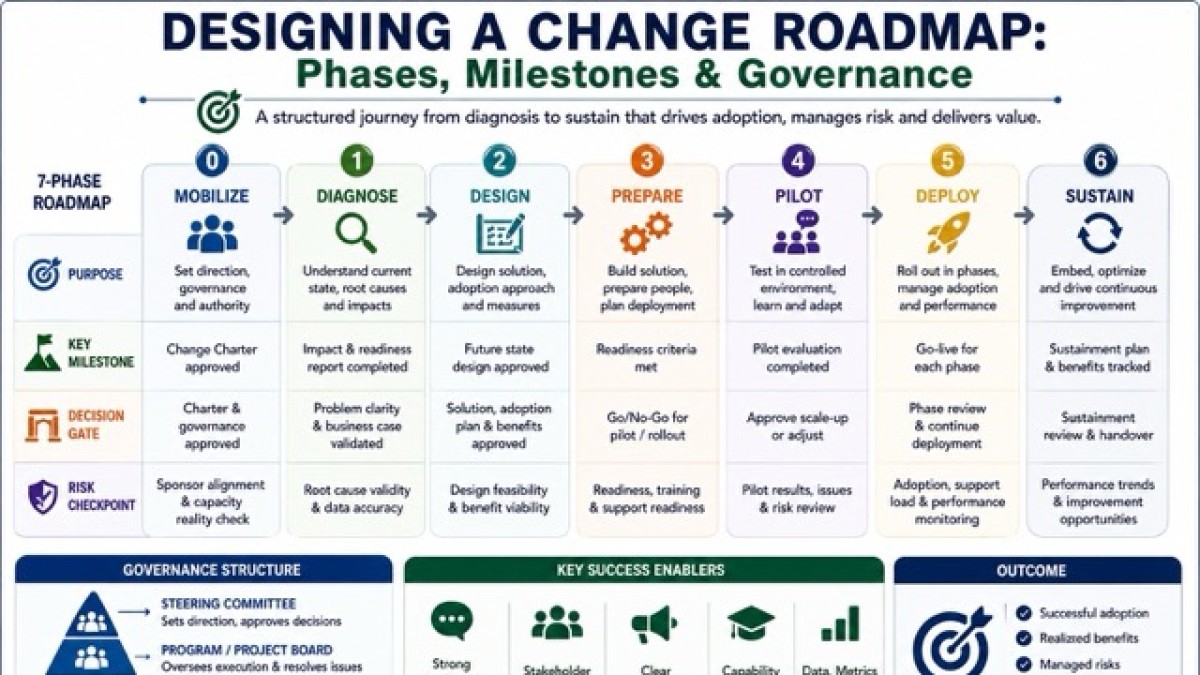
Design a change roadmap with phases, milestones, and governance—not a vague journey wish.

Most change initiatives don't fail because people are "resistant to change." They fail because the change was never designed as a journey.
Leaders approve a business case. A project team builds a solution. A go-live date gets fixed. Then the organization is expected to magically adopt new behaviours, new decisions, new roles, new metrics, and new ways of working on the same Monday morning.
That's not a roadmap. That's hope with a Gantt chart.
A real change roadmap is different. It is a structured sequence from diagnosis, design, deployment, sustain, with milestones that mean adoption, decision gates that protect value, and risk checkpoints that catch failure early; before it becomes expensive, political, and irreversible. This article walks you through how to build that roadmap, phase by phase, with examples.
What a change roadmap actually is (and what it is not)
A change roadmap is not a project plan. A project plan answers: What will we build, by when, with what resources? A change roadmap answers: How will the organization move from today's reality to the future state; safely, measurably, and sustainably?
So, a good change roadmap contains three layers, always:
- Delivery layer (solution): processes, systems, policy, org changes, training assets.
- Adoption layer (people): awareness, capability, commitment, behaviour, usage.
- Control layer (governance): decision rights, stage gates, escalation, risk checks, metrics.
If any one of these layers is missing, you don't have a change roadmap. You have an incomplete story.
A practical definition: "Phase - Milestone - Gate - Checkpoint"
When you design a change roadmap, force it into four constructs:
- a) Phase: a logical stage of work with a clear purpose.
- b) Milestone: a measurable outcome that signals progress (not just activity).
- c) Decision gate: a formal "stop / proceed / pivot" moment.
- d) Risk checkpoint: a deliberate test to detect predictable failure modes.
Think of it like aviation.
- a) Phases are flight stages (taxi, take off, cruise, landing).
- b) Milestones are measurable conditions (fuel checked, altitude reached, runway clear).
- c) Gates are permissions (ATC clearance).
- d) Risk checkpoints are mandatory safety checks.
No pilot says, "We will check the engine if we get time." That is how your change roadmap must feel.
The 7-phase change roadmap from diagnosis to sustain
Below is a complete roadmap structure you can use for most enterprise initiatives, ERP rollouts, operating model redesign, shared services, process standardization, facility governance, digital transformation, cost programs, even culture shifts. Now let's break down each phase in depth.
Phase 0: Mobilize (set authority before activity)
What this phase is for: Mobilize is where most leaders rush-and then regret. This is where you define the change as a managed program, not a loose initiative.
Core deliverables
1) Change Charter (1–2 pages):
- a) Why now (drivers, risks of inaction)
- b) Scope boundaries (what is included / excluded)
- c) Success measures (business + adoption)
- d) Guiding principles (how we will operate)
2) Governance design:
- a) Steering Committee (decision authority)
- b) Program / Project Board (execution oversight)
- C) Workstreams (solution + people)
- d) Escalation and decision rights
- a) Baseline: current KPIs, current behaviour indicators, current pain points.
- b) Resource & capacity plan: not headcount fantasy, actual available time.
Decision Gate 0: Charter approval. You do not begin design or build until:
- a) Sponsor agrees to measurable outcomes.
- b) Scope boundaries are documented.
- c) Decision authority is explicit.
Risk checkpoint: Sponsor alignment + capacity reality check. Ask two brutal questions early:
- Who will lose something because of this change? (power, budget, role identity)
- Do we have the capacity to absorb this change now? (peak season, parallel initiatives)
Example (ERP finance transformation): A company wants to implement a new ERP module for Accounts Payable. Mobilize reveals:
- a) Procurement and Finance both believe they "own vendor master data."
- b) The CFO wants speed; the CPO wants controls. If you don't resolve that decision right now, you will fight about it at go-live; when it's too late.
Phase 1: Diagnose (the organization's "truth phase")
What this phase is for. Diagnosis is not a survey exercise. It is root cause discovery.
You are answering:
- a) What is broken?
- b) Why is it broken?
- c) Who is impacted? •What must change (not just what must be built)?
Core deliverables
- As-Is process maps + pain points (including handoffs and exceptions)
- Stakeholder impact assessment
- a) Impacted groups
- b) Degree of change (low / medium / high)
- c) Likely resistance reasons
- Readiness assessment
- a) Sponsor strength
- b) Manager capability
- c) Change fatigue
- d) Communication maturity
- Change risk register (initial)
- top 10 risks, triggers, mitigation owners
Decision Gate 1: Problem statement sign-off
Your gate question: "Do we agree on the real problem and the real constraints?" If leaders can't agree here, your roadmap will become political later.
Risk checkpoint: "Truth audit". Do a structured "truth audit" across three lenses:
- Data truth: Are numbers trusted? Are baselines correct?
- Process truth: Is work actually done as documented?
- People truth: Who actually decides? Who influences? Who blocks?
Example (standardizing SOPs across multi-site facilities).
Diagnosis often reveals:
- a) Sites "comply on paper" but improvise in practice.
- b) The "same SOP" means 12 different behaviours.
- c) Managers are rewarded for local speed, not standard compliance.
So, the change is not "write SOPs." The change is changing the reward system + audits + coaching routines.
Phase 2: Design (future state plus the path to adoption)
What this phase is for. Design is where you define:
- a) The future state (process, tech, roles, measures)
- b) The change strategy (how you'll move people)
Most teams design the solution and forget to design the adoption engine. Don't.
Core deliverables
1) To-Be process / operating model
- a) Roles, decision points, handoffs
- c) Controls and compliance requirements
2) Change strategy
- a) Stakeholder strategy (who needs what, when)
- b) Communication architecture (cadence + channels + owners)
- c) Training & capability strategy (role-based)
- d) Reinforcement strategy (manager routines + recognition)
Benefits logic & measurement plan
benefits → leading indicators → adoption metrics → data source
3) Wave / release strategy
- a) Pilot vs big-bang
- b) Sequencing by risk, readiness, and dependency
Decision Gate 2: Design approval
Gate question: "Is the future state clear, feasible, and owned?" This is where you force hard decisions:
- a) Role changes
- b) Policy changes
- c) Control changes
- d) KPI changes
Risk checkpoint: Feasibility + compliance + role clarity Run three tests:
- Feasibility test: Do we have skills, tools, and timeline realism?
- Compliance test: Have statutory / audit constraints been embedded?
- Role clarity test: Can each impacted role answer:
- a) "What stops?"
- b) "What starts?"
- c) "What changes?" Example (shared services implementation).
Design reveals:
- a) Business units fear losing control of payments.
- b) Shared services needs standardization, but units have special approvals. The design response is not "convince them."
It is to build:
- a) Clear exception rules
- b) Transparent SLAs
- c) Escalation process
- d) Audit-friendly approvals
That becomes part of the roadmap.
Phase 3: Prepare (readiness is built, not assumed)
What this phase is for. Preparation is where you make adoption possible.
Not by motivation speeches. By practical enablement.
Core deliverables
1) Change network / champions model
- a) Selection criteria
- b) Responsibilities
- c) Weekly cadence
- d) Feedback loops
2) Training and performance support
- a) Role-based learning paths
- b) Job aids, quick reference guides, SOP summaries
- c) Simulations / practice environments (where relevant)
3) Manager enablement
- a) Talking points
- b) Team huddles structure
- c) Coaching guides
4) Cutover / transition plan
- a) What changes on Day 1
- b) What support exists
- c) How issues are logged and resolved
Readiness scorecard
thresholds for go-live permission Decision Gate
3: Readiness-to-deploy
This is your "no-go unless ready" gate.. Minimum readiness thresholds typically include:
- a) Training completion for critical roles (not 100% everywhere, critical first)
- b) Support model staffed (help desk, super users, escalation)
- c) Communications delivered (what / why / when / how)
- d) Data / process sign-offs complete
Risk checkpoint: Readiness scorecard with minimum thresholds
Common readiness categories:
- a) Sponsor & manager readiness
- b) People capability readiness
- c) Process & controls readiness
- d) Technology readiness
- e) Service continuity readiness
Example (new customer service process + CRM)
Preparation often fails when:
- a) Training happens after the system goes live
- b) Managers don't know how to coach
- c) The help desk is not briefed
Your roadmap should show:
- a) Training waves before go-live
- b) Manager huddles starting two weeks prior
- c) Hypercare staffing for first 4–6 weeks
Phase 4: Implement (go-live is a beginning, not the end)
What this phase is for. Implementation is the controlled transition from "old" to "new."
Your focus is not perfection. Your focus is stability + adoption momentum.
Core deliverables
1) Go-live execution
- a) Cutover checklist
- b) Communications
- c) Role activation
2) Hypercare / stabilization support
- a) War room cadence
- b) Issue triage rules (severity, ownership, response time)
3) Adoption tracking
- a) Usage metrics (system / process)
- b) Behaviour indicators (e.g., approvals done in new workflow)
- c) Sentiment signals (frontline feedback)
Decision log + scope control
prevent uncontrolled "improvements" that break governance
Decision Gate 4: Go-live authorization. Go-live permission should not be a calendar event. It should be a decision.
Gate question: "Are risks controlled enough to proceed without harming operations?"
Risk checkpoint: Service continuity + adoption monitoring. Two failures kill credibility fast:
- a) Service disruptions (customers, payroll, safety, compliance)
- b) Confusion without support ("we were trained once, months ago")
Example (policy-driven safety change across worksites)
If safety protocols change:
- a) You must ensure signage, equipment, training, and enforcement are live together
- b) Your roadmap must include compliance audits in the first week, not the first quarter
Phase 5: Stabilize (convert chaos into routine)
What this phase is for. Stabilization is where adoption becomes habit, or collapses back to old ways.
This is where most programs underinvest, because everyone is "tired." That is exactly why it matters.
Core deliverables
1) Stabilization plan
- a) Known issues resolution backlog
- b) Process refinements (controlled, not random)
2) Standard work / SOP embedding
updated SOPs, checklists, control points
3) Performance dashboards
- a) Leading indicators (cycle time, error rates)
- b) Adoption indicators (usage, compliance)
4) Reinforcement mechanisms
- a) Manager reviews
- b) Recognition
- c) Corrective action for non-compliance (where needed)
Decision Gate 5: Exit stabilization Gate question: "Is the new way stable enough to run without program support?"
Risk checkpoint: Defect trend + performance trend. You exit stabilization only when:
- a) Defects are trending down consistently
- b) Performance is at or near baseline (or improving)
- c) Users know where to go for help
- d) Owners are taking accountability
Example (procure-to-pay process redesign): If error rates in vendor payments spike after go-live, stabilization must include:
- a) Targeted retraining for specific roles
- b) Process correction where ambiguity exists
- c) Approvals tightening temporarily
Your roadmap should explicitly show these stabilization actions, not hide them.
Phase 6: Sustain (make it stick and make it better)
What this phase is for. Sustain is where change becomes "how we do business." This is not soft. It is operational discipline.
Core deliverables
1) BAU ownership handover
- a) Who owns the process, metrics, and training updates
2) Audit and compliance integration
- a) Periodic audits
- b) Control testing
3) Continuous improvement loop
- a) Feedback capture
- b) Improvement backlog
- c) Prioritization routine
4) Benefits realization tracking
- a) Compare actual vs expected
- b) Corrective actions if benefits lag
Decision Gate 6: BAU acceptance Gate question: "Has the organization truly taken ownership—without the program?"
Risk checkpoint: Sustainment controls + benefits realization. Sustainment fails when:
- a) KPIs are not owned
- b) Audits are not scheduled
- c) Training is not refreshed for new joiners
- d) Leadership attention moves on
Your roadmap must include these controls as milestones, not footnotes.
How to design milestones that actually matter (not vanity milestones)
Most roadmaps use milestones like:
- a) "Training completed"
- b) "Communication sent"
- c) "System deployed"
Those are activity milestones. They don't prove adoption.
Adoption-oriented milestones sound like:
- a) "80% of transactions processed in the new workflow with <2% error rate"
- b) "All managers conduct weekly change huddles for four consecutive weeks"
- c) "Audit confirms compliance with new controls across 3 cycles"
A simple milestone rule. Every milestone should contain at least one measurable verb:
using, completing, performing, complying, achieving, reducing, increasing
And it should be tied to:
- a) A role
- b) A metric
- c) A timeframe
Decision gates: your "value protection system"
A roadmap without gates is a train with no brakes.
Use gates to prevent these classic failures:
- a) Building the wrong solution
- b) Deploying before readiness
- c) "Go-live" without support
- d) Exiting stabilization too early
- e) Claiming benefits without evidence
Recommended stage gates (with what leaders must decide)
- 1. Gate 0 – Charter & governance
- a) Approve scope, outcomes, decision rights, resources
- 2. Gate 1 – Diagnosis
- A) Agree on root causes and constraints
- 3. Gate 2 – Future state design
- a) Approve operating model, role changes, controls, measurement
- 4. Gate 3 – Deployment readiness
- a) approve go-live only if minimum readiness thresholds met
- 5.Gate 4 – Go-live
- a) Approve cutover and continuity plan
- 6. Gate5 – Stabilization exit
- a) Approve exit only if defect / performance trends are stable
- 7.Gate6 – Sustainment
- a) Approve BAU ownership and ongoing control plan
Risk checkpoints: catch predictable failure modes early
Risk checkpoints are not the same as a risk register. A risk register is a list. A checkpoint is a test.
High-value checkpoints to build into your roadmap
- Sponsor alignment checkpoint (early)
- a) Test: do sponsors agree on outcomes, trade-offs, and who decides?
- Stakeholder resistance checkpoint (before build locks)
- a) Test: have you engaged the groups who will lose something?
- Capacity checkpoint (before deployment)
- a) Test: can operations absorb training, new routines, and transition load?
- Role clarity checkpoint (before training finalization)
- a) Test: can every critical role articulate "stop/start/change"?
- Readiness threshold checkpoint (before go-live)
- a) Test: does readiness scorecard meet minimums?
- Service continuity checkpoint (go-live week)
- a) Test: are support, escalation, and fallback in place?
- Stabilization trend checkpoint (weeks 2–6)
- A) Test: are errors reducing and performance stabilizing?
- Sustainment control checkpoint (month 2–3)
- a) Test: have audits, KPIs, and training refresh cycles been assigned?
Governance: the engine that keeps the roadmap real
Governance is not "meetings." Governance is decision discipline.
The minimum governance model (practical and enough)
- Steering Committee (monthly / fortnightly)
- a) Owns outcomes and major trade-offs
- b) Approves gates •Removes blockers
- Program / Change Control Board (weekly)
- a) Reviews progress vs roadmap
- b) Manages scope, decisions, and risk
- c) Ensures integration across workstreams
- Workstream cadences (weekly / twice weekly)
- a) Solution stream: build, test, deploy
- b) Change stream: comms, training, readiness, adoption tracking
- c) Operations stream: continuity, staffing, policy enforcement
- Change Network (weekly pulse + feedback)
- a) Champions / super users •local sensing mechanism
- b) Early warning system
Governance artefacts that make it work
- a) Decision log (what was decided, when, by whom, why)
- b) RAID log (Risks, Assumptions, Issues, Dependencies)
- c) Readiness dashboard (traffic lights with thresholds)
- d) Adoption dashboard (usage + behaviour + performance)
- e) Benefits tracker (expected vs actual, with actions)
If these artefacts don't exist, governance is theatre.
A worked example: Change roadmap for a multi-site operating model rollout
Scenario: A company standardizes operations across 20 sites (common SOPs, common audits, common controls).
Phase-wise milestones (example)
- a) Mobilize: governance formed; site leaders aligned on "non-negotiables"
- b) Diagnose: site variance mapped; top 10 risks documented; readiness baseline captured
- c) Design: standard SOP pack + audit model + escalation rules approved
- d) Prepare: site champions trained; manager coaching routines launched; readiness thresholds achieved for Wave 1 sites
- e) Implement: Wave 1 goes live; hypercare war room runs daily; adoption metrics tracked
- f) Stabilize: audit compliance reaches 90%+ across 3 cycles; defect trend down
- g) Sustain: monthly audits owned by BAU; onboarding training integrated; CI backlog running
Decision gates that matter here
- a) Gate 2 (design): approve what is standard vs what may remain local
- b) Gate 3 (readiness): do not wave-deploy a site that fails readiness thresholds
- c) Gate 5 (stabilization): do not declare success until audits confirm consistency
Risk checkpoints that save you
- a) Capacity checkpoint: peak season at some sites, delay wave sequencing
- b) Role clarity checkpoint: supervisors must know enforcement authority
- c) Sustainment checkpoint: audit calendar and accountability locked
Common roadmap mistakes (and the correction)
- Mistake: Roadmap is only project tasks
Correction: include adoption milestones + governance gates. - Mistake: Training is a single event
Correction: build a learning path + reinforcement + refresh cycles. - Mistake: Go-live is treated as completion Correction:
design stabilization and sustainment as real phases with owners and metrics. - Mistake: Governance is vague
Correction: define decision rights, thresholds, escalation paths, and artefacts. - Mistake: Risks are documented but not tested
Correction: create non-negotiable checkpoints with pass / fail criteria.
A simple "Roadmap Pack" you can reuse for any initiative
If you want a practical output set, build these 8 artefacts:
- One-page roadmap (phases + milestones + gates)
- Stakeholder impact map (groups × impact × risk)
- Governance charter (bodies, cadence, decision rights)
- Stage-gate checklist (entry/exit criteria)
- Readiness scorecard (threshold-based)
- Change risk register (top risks with triggers + owners)
- Adoption dashboard (usage + behaviour + performance indicators)
- Sustainment plan (audits, KPI ownership, training refresh)
This pack is what turns change into a system.
Closing insight: a roadmap is a contract with reality
A change roadmap is not a pretty diagram for a presentation. It is a contract:
- a) With the organization's capacity,
- b) With leadership's decision discipline,
- c) With frontline reality,
- d) And with the truth that adoption takes time and reinforcement.
Design your roadmap so that progress is earned, not declared.
Make gates protect value. Make checkpoints catch failure early. Make milestones prove behaviour, not activity.
Then your change initiative stops being a heroic effort. It becomes a controlled transformation.
Categories: : Governance