Culture of Continuous Improvement
 ACTSol and Associates
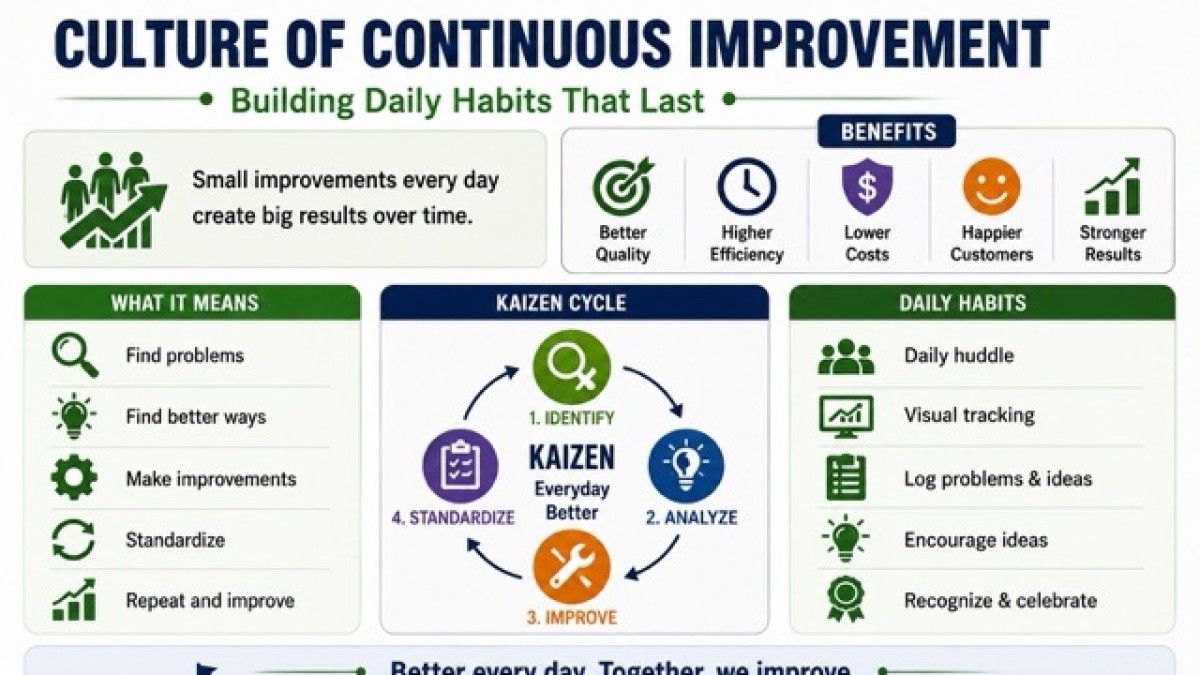
Build continuous improvement as a daily habit—Kaizen, employee involvement, reviews, and recognition.
Building Daily Improvement Habits That Last

Continuous improvement is not a one-time initiative, a special project, or an annual management exercise. It is a way of working. It is the discipline of making work better every day through small, practical, employee-led improvements supported by leaders, systems, reviews, and recognition. In the wider journey of process excellence, this subject naturally belongs with agile, lean, and continuous improvement themes, where structured improvement methods are blended with practical workplace habits.
Many organizations speak about improvement, but only a few build it into daily behavior. Some companies launch large transformation programs, conduct workshops, create dashboards, and announce bold targets. Yet, after some time, the energy fades. Employees return to old working patterns.
Problems remain unresolved. Suggestions stop coming. Reviews become routine. The real challenge is not starting improvement. The real challenge is making improvement a daily habit.
A culture of continuous improvement is created when every employee begins to ask simple but powerful questions:
- What problem did we face today?
- Why did it happen?
- Can we make this step simpler?
- Can we reduce waiting time?
- Can we avoid rework?
- Can we improve quality?
- Can we make the customer experience better?
- Can we make work safer, faster, cleaner, and more reliable?
When such questions become part of normal work, improvement stops being an event and becomes a culture.
What Continuous Improvement Really Means
Continuous improvement means making regular, small, and systematic improvements in processes, systems, habits, and behaviors. It does not always require big investment, complex technology, or external consultants. Often, the most powerful improvements come from the people who do the work every day.
A warehouse employee may suggest a better location for frequently used materials. A customer service executive may identify a repeated complaint pattern. A machine operator may notice a setting that reduces defects. An accounts executive may suggest a checklist to avoid payment delays. A sales coordinator may simplify the order confirmation process. These are not dramatic changes, but together they create better performance.
Continuous improvement focuses on eliminating waste, reducing errors, improving flow, increasing reliability, and making work easier for employees and better for customers. It builds a mindset that says: “The current way of working may be acceptable, but it can still be improved.”
This mindset is very different from a blame culture. In a blame culture, problems are hidden. Employees fear being questioned. Mistakes are personalized. In an improvement culture, problems are surfaced.
Processes are examined. Root causes are discussed. Employees are encouraged to speak up. The organization learns.
Kaizen: The Foundation of Daily Improvement
Kaizen is one of the most practical concepts behind continuous improvement. The word Kaizen is commonly understood as “change for better” or “continuous improvement.” Its strength lies in its simplicity. Kaizen does not wait for major transformation. It encourages small, frequent, low-cost improvements made by people close to the work.
In many organizations, improvement is treated as a management responsibility. Senior leaders define projects, managers execute them, and employees are expected to follow. Kaizen reverses this thinking. It says that improvement must involve everyone. Operators, supervisors, executives, managers, and leaders must all participate.
A Kaizen approach can be applied to almost any function. In production, it may reduce movement, waiting, defects, or machine downtime. In HR, it may improve onboarding, attendance tracking, or employee query resolution. In finance, it may reduce invoice processing delays. In sales, it may improve lead follow-up discipline. In procurement, it may reduce vendor approval cycle time. In IT, it may improve ticket response time.
The power of Kaizen is that it makes improvement non-threatening. Employees do not need to propose revolutionary ideas. They can suggest simple corrections: remove one unnecessary approval, improve one format, change one layout, add one checklist, clarify one responsibility, or automate one repeated manual task.
Over time, these small improvements create large organizational impact.
Building Daily Improvement Habits
A culture of continuous improvement cannot depend only on slogans such as “Quality First” or “Think Improvement.” It needs daily habits. Habits are repeated behaviors. When improvement becomes part of everyday routines, culture begins to change.
One useful habit is the daily team huddle. A short 10–15 minute discussion can help teams review yesterday’s performance, today’s priorities, problems faced, and improvement actions. The purpose is not to conduct a long meeting. The purpose is to create awareness and quick correction.
Another habit is visual tracking. Teams should be able to see their key performance indicators, open issues, pending actions, defects, delays, and improvement ideas. What is visible gets discussed. What gets discussed gets improved.
A third habit is problem logging. Many organizations lose improvement opportunities because problems are discussed verbally and forgotten. A simple issue log can capture the problem, date, owner, root cause, action, target date, and status. This creates accountability.
A fourth habit is asking “why” before jumping to solutions. When a delay, defect, complaint, or deviation occurs, teams often rush to fix the immediate issue. While that is necessary, continuous improvement requires deeper thinking. Why did it happen? Why was it not detected earlier? Why does the process allow such an error? Why is the same issue repeating?
A fifth habit is standardization after improvement. If a better method is found, it should be documented, communicated, trained, and monitored. Otherwise, improvement remains individual-dependent. Standardization converts local learning into organizational discipline.
Employee Involvement: The Heart of Improvement
Employees are not merely resources who execute processes. They are the people who understand the practical reality of work. They know where delays happen, where confusion exists, which approvals are unnecessary, which formats are difficult, where customers complain, and where systems do not support actual operations.
Therefore, employee involvement is essential for continuous improvement. When employees are involved, improvement becomes practical. When they are ignored, improvement becomes theoretical.
Organizations must create safe channels for employees to raise issues and ideas. People should not feel that pointing out problems will be seen as criticism. Leaders and managers must clearly communicate that identifying problems is a positive behavior. A problem hidden is a risk. A problem reported is an opportunity.
Employee involvement also improves ownership. When employees help design improvements, they are more likely to follow them. They do not see the change as something imposed from above. They see it as something they helped create.
However, involvement should not be limited to asking for suggestions. Employees must also be included in analysis, testing, implementation, and review. For example, if a shopfloor team suggests a layout change, they should be involved in testing the new layout. If a finance executive suggests an invoice checklist, they should help design and refine it. If a customer service employee identifies repeated customer complaints, they should be part of the corrective action discussion.
Participation builds commitment.
Leadership Support: The Culture Multiplier
Continuous improvement cannot survive without leadership support. Leaders shape culture through what they ask, what they review, what they appreciate, and what they tolerate.
If leaders only ask about monthly targets, people focus only on numbers. If leaders ask about process gaps, root causes, learning, and improvement actions, people begin to focus on improvement. The questions leaders ask repeatedly become the priorities of the organization.
Leadership support does not mean leaders must solve every problem. In fact, the best leaders do not take over every improvement activity. They create the environment where teams can identify and solve problems themselves. They remove barriers, provide resources, encourage experimentation, and protect employees from blame when genuine improvement attempts fail.
Leaders must also demonstrate patience. A continuous improvement culture does not develop overnight. In the beginning, suggestions may be weak. Reviews may be inconsistent. Employees may hesitate. Managers may treat it as extra work. But if leaders remain consistent, the system matures.
The most powerful leadership behavior is going to the workplace, observing the process, listening to employees, and asking respectful questions. This is often more effective than reviewing reports from a conference room. When leaders show interest in real work, employees begin to believe that improvement matters.
Suggestion Systems That Actually Work
Many organizations have suggestion schemes, but not all of them work. Some become symbolic. Employees submit ideas, but no action is taken. Responses are delayed. Ideas disappear into a system. Eventually, people stop participating.
A good suggestion system must be simple, transparent, and action-oriented. Employees should be able to submit ideas easily. The format should not be complicated. A basic suggestion can capture the current problem, proposed improvement, expected benefit, and department involved.
The most important part is response time. Every suggestion must be acknowledged. It may be accepted, modified, tested, deferred, or rejected, but it should not be ignored. Even when an idea is not practical, the employee should receive respectful feedback. This keeps trust alive.
Suggestions can be categorized into areas such as cost saving, time saving, quality improvement, safety improvement, customer experience, compliance, workplace organization, digital improvement, and employee convenience. This helps management track the nature of improvement ideas.
Small ideas should be implemented quickly. Not every suggestion needs a committee. If the improvement is low-risk, low-cost, and beneficial, supervisors should be empowered to approve and implement it. Larger ideas may need review by cross-functional teams.
A good suggestion system also shares implemented ideas with others. When employees see that suggestions are acted upon, participation increases. Visibility creates confidence.
Review Mechanisms: Keeping Improvement Alive
Without review, continuous improvement becomes casual. Review mechanisms convert good intentions into disciplined action.
Organizations should create a practical review structure at different levels. At the team level, daily or weekly reviews can focus on immediate issues, small improvements, and action status. At the departmental level, monthly reviews can examine process performance, recurring problems, improvement projects, and employee suggestions. At the leadership level, quarterly reviews can focus on major themes, cross-functional bottlenecks, savings, customer impact, and cultural progress.
The review should not become a fault-finding exercise. It should focus on learning and progress. Useful questions include:
- What improved this month?
- Which problems are repeating?
- Which suggestions were implemented?
- Which process needs redesign?
- Where are approvals getting delayed?
- Which KPIs are not improving?
- What support do teams need?
Data plays an important role in reviews. Improvement must be supported by facts. Teams should track cycle time, defect rates, rework, complaints, downtime, productivity, cost, safety incidents, audit findings, and other relevant indicators. However, data should be used to understand the process, not to blame individuals.
Every review must end with clear actions. An improvement review without action tracking becomes discussion without discipline. Each action should have an owner, target date, expected outcome, and status.
Recognition: Reinforcing the Right Behavior
Recognition is one of the most powerful tools for sustaining continuous improvement. People repeat behaviors that are noticed and valued.
Recognition does not always have to be monetary. Appreciation in a team meeting, a certificate, a message from senior leadership, display on an improvement board, opportunity to present to management, or inclusion in performance discussions can all motivate employees.
Recognition should not only reward big cost savings. It should also appreciate problem identification, teamwork, disciplined follow-up, customer-focused improvements, safety improvements, and learning from failure. If only large financial benefits are recognized, employees may ignore small but valuable improvements.
Team-based recognition is especially important. Many improvements require collaboration across departments. For example, reducing order processing time may involve sales, finance, operations, logistics, and IT. Recognizing only one person may weaken teamwork. Recognizing the team reinforces cross-functional improvement.
Recognition must be fair and transparent. Employees should understand what kind of improvement behavior is appreciated. The criteria may include usefulness, implementation, measurable benefit, creativity, simplicity, and sustainability.
Making Continuous Improvement Part of SOPs and Process Governance
Continuous improvement should not remain separate from standard operating procedures. SOPs define how work should be done. Continuous improvement ensures that SOPs remain practical, current, and effective.
Every SOP should have a review mechanism. Teams should be encouraged to identify gaps in SOPs during actual execution. If a step is unclear, duplicated, outdated, or difficult to follow, it should be improved. This prevents SOPs from becoming static documents.
Internal audits, customer complaints, non-conformities, process deviations, and performance reviews should all feed into improvement actions. In this way, improvement becomes part of governance. It is not an additional activity; it becomes embedded in how the organization manages work.
Organizations can also maintain an improvement register. This register can track improvement ideas, approved actions, implemented changes, benefits achieved, SOP updates required, and recognition given. Over time, this becomes a knowledge base of organizational learning.
Common Barriers to Continuous Improvement
Many organizations struggle to sustain improvement because of predictable barriers.
One common barrier is lack of time. Employees say they are too busy with daily work. The solution is to make improvement part of daily work, not an extra activity. Short huddles, simple logs, and quick actions help.
Another barrier is fear of blame. If employees are punished for raising problems, they will hide issues. Leaders must separate human error, process weakness, and negligence. Most problems need process correction, not personal blame.
A third barrier is poor follow-up. When suggestions are not acted upon, employees lose trust. A visible tracking system is essential.
A fourth barrier is leadership inconsistency. If leaders discuss improvement only during campaigns, the culture will not sustain. Improvement must be reviewed regularly.
A fifth barrier is overcomplication. Heavy formats, long approvals, and complex methods discourage participation. Continuous improvement should be simple enough for everyone to practice.
Conclusion: Improvement as a Daily Discipline
A culture of continuous improvement is built through daily habits, not occasional enthusiasm. It grows when employees are involved, leaders are supportive, suggestions are respected, reviews are disciplined, and recognition is meaningful.
Kaizen teaches organizations that small improvements matter. Employee involvement ensures that improvements are practical. Leadership support gives improvement legitimacy. Suggestion systems create participation. Review mechanisms create accountability. Recognition creates motivation. Together, these elements convert continuous improvement from a management concept into an organizational way of life.
The best organizations do not wait for problems to become crises. They improve before failure becomes visible. They listen before employees become disengaged. They review before performance declines. They recognize before enthusiasm fades.
Continuous improvement is not about perfection. It is about progress. It is about creating an organization where every person, every process, and every day carries the possibility of becoming better.
Categories: : Governance