Change Governance: Steering Committees, Change Champions & PMOs
 ACTSol and Associates
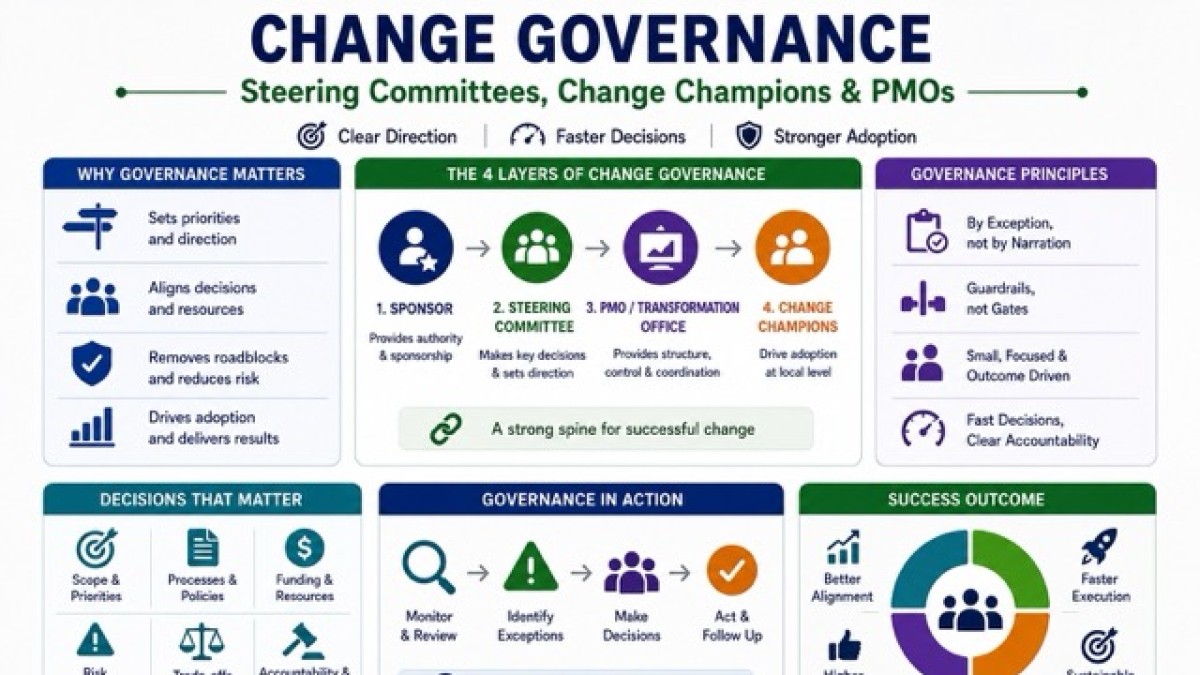
Steering committees, champions, and PMOs that actually decide and steer change.

Most change programs don’t fail because the idea was bad. They fail because nobody was truly steering.
Decisions drift. Priorities collide. Local realities get ignored. Risks sit on someone’s desk “for later.” And the program becomes a polite parade of status updates until delivery slips, adoption stalls, and everyone quietly agrees the organisation is “resistant to change.”
That’s not resistance. That’s absence of governance.
Good change governance is not a heavyweight bureaucracy. It’s not a calendar full of meetings. It’s not a 40-slide deck that gets “noted” every fortnight.
Good change governance is a decision system.
It gives direction without suffocating teams. It removes ambiguity without removing ownership. It speeds up decisions by making decision rights explicit so change moves like a well-led operation, not a committee-driven debate.
This article shows how to design governance that adds control + speed, not deadweight. And it clarifies what sponsors, steering committees, PMOs, and local change champions must do practically, in real organisations.
Why governance matters more than your change plan.
Governance is how you test and correct it in the real world. Because reality always arrives:
- a) A business leader “supports the change” but won’t release people for training.
- b) The new process works in HQ but fails at site/branch level.
- c) IT delivers features, but operations refuses to adopt them.
- d) One department keeps old KPIs and kills the new behaviour.
- e) Everyone agrees the change is important until quarterly numbers wobble.
Governance is what prevents these situations from becoming “project issues” that linger for weeks.
It forces the organisation to answer hard questions quickly:
- a) What is the priority? •Who decides?
- b) What trade-off are we accepting?
- c) What behaviour must change, and how will we enforce it?
- d) What happens if adoption doesn’t happen?
If you can’t answer these questions fast, you don’t have governance.
You have meetings.
The goal: Direction without bureaucracy. Here’s the simplest way to frame it:
Governance should create clarity, momentum, and protection.
- a) Clarity: decision rights, priorities, success measures, non-negotiables.
- b) Momentum: cadence, escalation paths, fast approvals, quick unblocking.
- c) Protection: sponsorship muscle, resource cover, conflict resolution.
If your governance doesn’t do these three things, it’s decorative. If it does these three things, it becomes the backbone of delivery and adoption.
The “Minimum Viable Governance” model
You do not need seven committees. You need four layers that work cleanly together:
- Sponsor (single accountable executive)
- Steering Committee (direction + decision-making)
- PMO / Transformation Office (coordination + control tower)
- Local Change Champions network (adoption engine)
Think of this like a spine:
- a) Sponsor provides authority.
- b) Steering provides decisions.
- c) PMO provides execution discipline.
- d) Champions provide local traction. Everything else is optional.
Design principle: Governance must be “by exception,” not “by narration”
Most governance collapses into storytelling. Teams narrate. Leaders listen. Everybody “notes.” Then the program limps forward until the next narration session. High-performing governance works differently:
- a) Routine items are handled at working level.
- b) Only exceptions go upward.
- c) Exceptions trigger decisions within days, not weeks.
Governance-by-exception requires three things:
- a) Clear thresholds (what must be escalated).
- b) A simple dashboard (so exceptions are visible early).
- c) A sponsor / steerco that is willing to decide, not defer.
Step-by-step: How to design a governance structure that doesn’t become deadweight
1) Start with decision rights, not org charts
Ask: “What decisions will make or break this change?”
Typical decision categories:
- a) Scope: what is in/out; where we pilot; rollout sequencing
- b) Policy & process: what becomes mandatory; what remains flexible
- c) Funding & resourcing: people time, external vendors, training budgets
- d) Risk acceptance: what risk we tolerate vs mitigate
- e) Trade-offs: speed vs quality, standardisation vs local flexibility
- f) Accountability enforcement: consequences for non-compliance
Now assign each decision category to a governance level. If you don’t assign decision rights, you will get delay disguised as “alignment.”
2) Build “guardrails,” not “gates”
Governance becomes bureaucracy when every small action needs approval. Instead, define guardrails like:
- a) “Local teams may adjust steps A and B, but steps C and D are mandatory.”
- b) “Any deviation impacting compliance must be approved by Sponsor/SteerCo.”
- c) “Training cannot be skipped for roles X and Y.”
- d) “Go-live is allowed only when readiness score ≥ 80%.”
Guardrails keep control high and friction low.
3) Keep committees small, sharp, and senior enough to decide
The steering committee is not a town hall. It’s a decision body. A good SteerCo has:
- a) 6–10 members
- b) Authority over cross-functional conflicts
- c) Budget / resource influence
- d) Operational representation (not only corporate functions)
If your SteerCo has 18 people, it’s not governance. It’s a seminar.
4) Fix the cadence: fewer meetings, better triggers
A common cadence that works:
- a) Weekly: PMO / workstream leads (execution + risks)
- b) Fortnightly: Sponsor check-in (top blockers, adoption health)
- c) Monthly: Steering committee (decisions + prioritisation)
- d) Quarterly: business outcomes review (benefits + behavioural adoption)
But cadence alone is not enough.
You need triggers:
- a) “If adoption drops below X, escalate within 48 hours.”
- b) “If a business unit refuses training, sponsor intervenes in 72 hours.”
- c) “If scope creep exceeds Y, Steer Co decides next meeting or via ad-hoc decision call.”
Triggers prevent drift.
5) Make one dashboard the “single source of truth”
The deadweight begins when every function brings its own deck. Unify the program around one control view:
A simple dashboard should show:
- a) Delivery status (milestones, critical path)
- b) Adoption / readiness (role-based training completion, usage, compliance)
- c) Risks / issues (top 10, ageing, owner, due date)
- d) Decisions required (what, by whom, by when)
- e) Benefits leading indicators (cycle time, error rate, rework, customer impact)
If the dashboard doesn’t drive decisions, it’s theatre.
Roles clarified: Who does what (and what they must stop doing)
1) The Sponsor: “Owns the change, not the project”
Core role: Provide authority, priority, and consequence management.
What a strong sponsor actually does:
- a) Defines the why in business language (not slogans)
- b) Makes the change a priority when trade-offs show up
- c) Removes organisational blockers (resources, conflicts, incentives)
- d) Holds leaders accountable for adoption (not only delivery)
- e) Sponsors the narrative: “This is the new way we work.”
What sponsors must stop doing:
- a) Delegating sponsorship to the PMO
- b) Appearing only at kick-off and go-live
- c) Asking for more reporting instead of making decisions
Example (CRM rollout in an auto-leasing company): Sales is enthusiastic, but regional heads keep old pipelines and ignore the CRM. The sponsor steps in and changes the weekly sales review to be CRM-based only. No CRM entries = no pipeline discussion. Adoption jumps without extra training. That’s sponsorship.
2) The Steering Committee: “Decides, prioritises, and protects”
Core role: Provide direction and cross-functional decision-making.
SteerCo responsibilities:
- a) Approve scope, sequencing, and key design choices
- b) Resolve conflicts between functions (“Operations vs IT vs Finance”)
- c) Approve exception requests (controlled deviations)
- d) Review adoption health and intervene when leaders stall
- e) Protect the program from organisational distractions
SteerCo outputs should be visible and binary:
- a) Approved / Not approved
- b) In scope / Out of scope
- c) Go / No-go
- d) Standard / Allowed deviation (with conditions)
What the SteerCo must stop doing:
- a) Asking for updates with no decisions
- b) Micromanaging workstream plans
- c) Allowing “we’ll take it offline” to become the default outcome
Example (ERP standardisation across plants/sites): Site A insists on keeping a local purchase approval flow. PMO flags it as a compliance + controls risk. SteerCo decides: either adopt standard flow or accept a formal deviation with compensating controls and a sunset date. This prevents “forever exceptions” that destroy standardisation.
3) The PMO (or Transformation Office): “Runs the control tower”
PMO is often misunderstood. A PMO is not a reporting factory. A good PMO is the program’s operating system.
Core role: Orchestrate delivery + readiness + risk control.
PMO responsibilities:
- a) Integrated plan (dependencies across workstreams)
- b) RAID management (risks, assumptions, issues, dependencies)
- c) Decision log and escalation management
- d) Progress tracking against milestones
- e) Readiness framework and go-live criteria
- f) Benefits tracking (with leading indicators)
- g) Communication rhythm (what goes out, when, and to whom)
PMO must also protect leaders from noise:
- a) Summarise, don’t dump data
- b) Surface only what needs decision or intervention
- c) Keep teams focused on outcomes, not documentation
What PMOs must stop doing:
- a) Measuring activity instead of adoption
- b) Publishing dashboards that nobody uses
- c) Letting workstreams operate like separate kingdoms
Example (new safety process in an EPC organisation): PMO notices training completion is high, but site incident reporting quality is low. They add a leading indicator: “% incident reports meeting quality checklist.” It reveals that supervisors don’t know how to classify incidents. PMO triggers micro-coaching and supervisor toolkits, improving reporting quality in two weeks. That’s control-tower governance; not slide-making.
4) Local Change Champions: “Turn intent into behaviour”
Champions are not cheerleaders. They are local translators and friction removers.
Core role: Drive adoption where real work happens.
Champion responsibilities:
- a) Explain “what changes for us” in local language
- b) Spot friction early (process gaps, local constraints, resistance points)
- c) Reinforce new behaviours in daily routines
- d) Support training transfer: job aids, shadowing, FAQs
- e) Provide feedback loops to PMO (what’s breaking, what’s working)
Champions need legitimacy:
- a) Chosen for influence and credibility, not availability
- b) Backed by local manager support
- c) Given time allocation (even if modest, but explicit)
What champions must stop doing:
- a) Acting as a messaging relay only
- b) Owning delivery tasks that belong to project teams
- c) Being selected as a token network with no real authority or time
Example (branch-level process change): A new customer onboarding checklist is rolled out. Champions in branches notice staff skip two steps because the system screens are slow. Champions escalate to PMO; PMO coordinates a quick UI tweak and updates the job aid. Adoption stabilises. Without champions, the program would blame “mindset.” With champions, it fixes the work.
Putting it together: A practical governance map (who meets, what they decide)
Weekly (PMO + Workstream Leads)
Purpose: Execution control and rapid unblocking
Agenda: milestone progress, dependency clashes, issue ageing, readiness gaps
Outputs: actions + escalations
Fortnightly (Sponsor + Program Lead / PMO Head)
Purpose: Sponsor intervention on top blockers
Agenda: top 5 issues, adoption hotspots, leadership non-compliance, decisions needed
Outputs: sponsor calls, priority decisions, enforcement actions
Monthly (Steering Committee)
Purpose: Direction and cross-functional decisions
Agenda: decisions required, scope trade-offs, exception approvals, adoption health, benefits trend
Outputs: approvals, resets, resource reallocations, go / no-go
Quarterly (Business Outcomes Review)
Purpose: Confirm benefits and behavioural embedment
Agenda: KPI movement, compliance, process performance, capability maturity
Outputs: sustain plan, performance ownership, next-wave roadmap
RACI snapshot: Clear accountability without confusion
Here’s a simple way to prevent role overlap:
- a) Sponsor: Accountable for outcomes and organisational enforcement
- b) SteerCo: Accountable for cross-functional decisions and priority conflicts
- c) PMO: Responsible for orchestration, reporting, escalation, and readiness gates
- d) Champions: Responsible for local adoption support and feedback loops
- e) Line Managers (often forgotten): Accountable for day-to-day behavioural compliance in their teams
That last line matters. Champions support adoption. Managers own it. If managers aren’t accountable, champions become unpaid babysitters.
How governance avoids “deadweight bureaucracy” in practice
1) Limit approvals to what truly matters
Approvals should be for:
- a) Policy / process “non-negotiables”
- b) Budget / resource shifts •compliance and risk acceptance
- c) Go-live readiness Everything else should be delegated.
2) Use readiness gates that are measurable and fair
Typical go-live gate criteria:
- a) Training completion for critical roles ≥ X%
- b) Role-based competency checks passed
- c) Process test results meet quality thresholds
- d) Support model ready (helpdesk, SOPs, escalation)
- e) Local readiness confirmed by champions + managers
- f) Data migration / technical stability verified (if digital) Readiness gates prevent political go-lives.
3) Make escalations time-bound
A governance system must have deadlines like:
- a) “Escalated issues must be assigned within 24 hours”
- b) “Decision requests must be answered within 5 working days”
- c) “Aged issues (>14 days) are automatically reviewed by sponsor” Time bounds create urgency without drama.
4) Measure adoption like a business metric, not a sentiment
Adoption indicators should be observable:
- a) System usage by role
- b) Compliance rate to new steps
- c) Cycle time reduction
- d) Error / rework reduction
- e) Audit findings trend
- f) Customer complaints linked to process changes If you only measure “communication sent” and “training delivered,” you are measuring effort, not adoption.
Common governance failure patterns (and how to fix them)
Failure 1: “We have a steering committee” (but it doesn’t steer)
Symptom: Lots of updates, few decisions.
Fix: Add a standing agenda section: Decisions Required (top of the meeting). If there are no decisions, cancel the meeting.
Failure 2: Sponsor is visible but not consequential
Symptom: Leaders ignore the change with no consequence.
Fix: Sponsor ties the change to operating rhythms; reviews, KPIs, performance discussions.
Failure 3: PMO becomes a reporting machine
Symptom: Teams spend more time preparing decks than solving problems.
Fix: Reduce reporting fields. Track fewer metrics but make them decision-worthy. Shift PMO focus to escalation and readiness.
Failure 4: Champions are enthusiastic but powerless
Symptom: Champions escalate issues but nothing changes.
Fix: Create a champion feedback SLA: “champion escalations acknowledged within 48 hours; resolution path within 7 days.”
Failure 5: Local realities are treated as “resistance”
Symptom: Adoption stalls in specific pockets; HQ blames culture.
Fix: Champions + managers run local barrier sessions. Convert barriers into engineering fixes, policy clarifications, or training redesign.
A realistic example: Governance for a multi-location rollout
Scenario: A company rolls out a new standard service workflow across 30 locations (mix of metro and non-metro).
What goes wrong without governance:
- a) Locations interpret steps differently.
- b) Managers keep old performance measures.
- c) Staff skip documentation to save time.
- d) Support teams get overwhelmed after go-live.
How governance prevents it:
- a) Sponsor mandates: “Service review happens only through the new workflow.”
- b) SteerCo decides: which steps are mandatory, which are flexible; approves a limited exception policy.
- c) PMO sets readiness gates and delays go-live for 6 locations until staffing/training stabilises.
- d) Champions flag that step 4 fails in low-bandwidth sites; PMO coordinates an offline workaround and updates job aids.
Outcome: rollout happens with controlled variation, fewer breakdowns, and faster stabilisation.
Governance didn’t add weight. It added coherence.
Practical checklist: Build your governance in 10 moves
- Name a single sponsor with real authority.
- Define decision categories and assign decision rights.
- Form a small SteerCo that can resolve conflicts.
- Create a PMO control tower with one dashboard.
- Use governance-by-exception thresholds.
- Set readiness gates with measurable criteria.
- Build a champion network based on influence, not availability.
- Lock the cadence + triggers (including time-bound escalations).
- Tie adoption to operating rhythms (reviews, KPIs, performance).
- Publish the governance charter: who decides what, and how fast.
If you do only these 10, you’ll beat most “mature governance models” that are mostly paperwork.
Closing insight: Governance is the organisation’s “commitment mechanism”
A change program is easy to approve in principle. It is hard to execute in the messy middle.
Governance is what converts the organisation’s intention into consistent decisions and daily behaviour; especially when priorities clash, pressure rises, and shortcuts look tempting.
So, design governance like you design a good process:
- a) Minimal steps
- b) Clear ownership
- c) Explicit controls
- d) Fast escalation
- d) Measurable outcomes
Direction without deadweight. That’s what real change governance looks like.
Categories: : Governance