Behavioral Science in Change & Process Adoption
 ACTSol and Associates
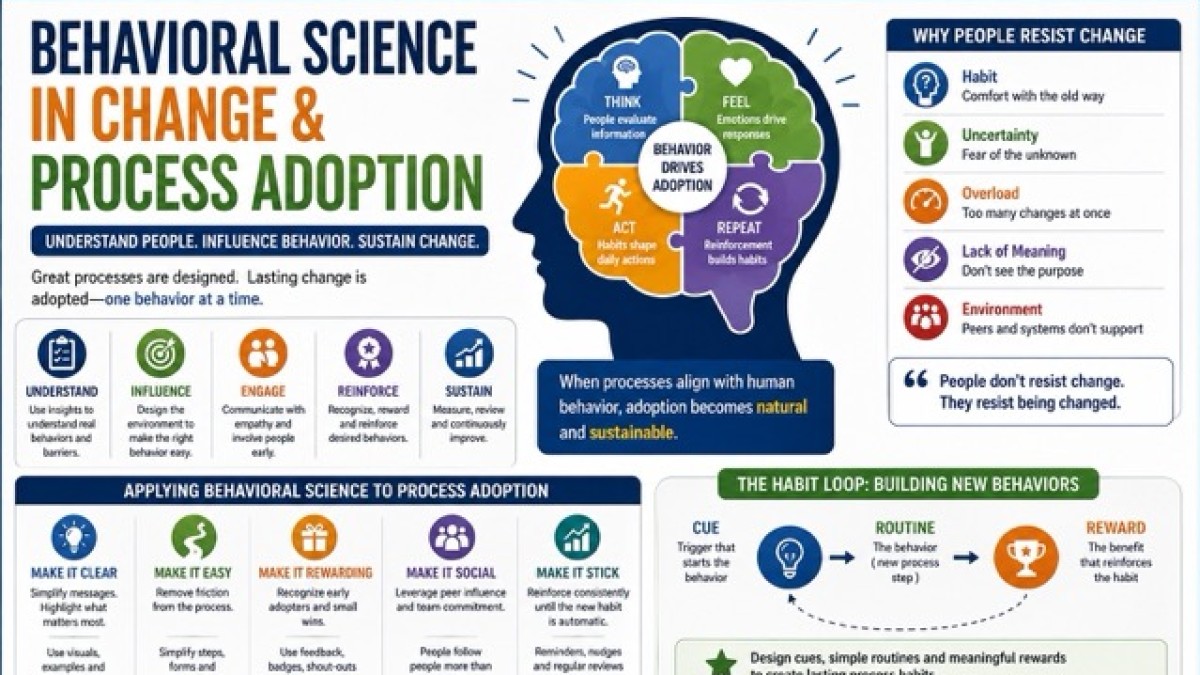
Use habits, nudges, and reinforcement so people adopt processes—not just read SOPs.

Organizations often believe that once a process is mapped, an SOP is written, and training is completed, people will automatically start following the new way of working. In reality, this rarely happens so smoothly. Processes are not adopted by documents; they are adopted by people. People bring habits, emotions, assumptions, shortcuts, pressures, fears, motivations, and workplace realities into every process change.
This is where behavioral science becomes extremely important.
Behavioral science helps us understand why people behave the way they do at work. It explains why employees may resist a change even when it is logical, why they may continue old practices even after new SOPs are issued, why reminders work better than long instructions, and why reinforcement is essential for sustaining adoption. In change management and process excellence, behavioral science shifts the focus from “Have we documented the process?” to “Are people actually willing and able to follow it every day?”
A process may be technically correct, but unless it fits human behavior, it will not become a working reality.
Process Adoption Is a Behavioral Challenge
Process adoption means people consistently follow the defined way of working. This includes using the right forms, following approval steps, recording data properly, escalating issues, using systems correctly, and completing activities within timelines.
However, adoption is not only a matter of knowledge. It is a matter of behavior.
An employee may know the SOP but still not follow it. A manager may approve a process but still bypass it during pressure. A team may attend training but return to the old method the next day. This happens because behavior is shaped by more than instructions. It is shaped by convenience, rewards, peer behavior, leadership signals, fear of consequences, workload, system design, confidence, and habit.
Therefore, successful change requires three things together: a well-designed process, clear communication, and behavioral enablement. When these three are aligned, adoption becomes easier. When they are disconnected, even the best SOP remains unused.
The Power of Habits in Process Adoption
Much of daily work is habit-driven. Employees do not consciously think through every step of every activity. Over time, they develop routines, shortcuts, and familiar ways of doing things. These habits help them work faster, but they can also become barriers to change.
For example, if a purchase request was earlier approved informally over a phone call, employees may continue doing that even after a formal approval workflow is introduced. If sales teams were used to keeping customer follow-up details in personal notebooks, they may resist updating the CRM system daily. If plant teams were used to verbally reporting breakdowns, they may not immediately adopt a digital maintenance log.
The issue is not always indiscipline. Often, the old habit is stronger than the new instruction.
To change behavior, organizations must understand the habit loop. A habit usually has three parts: cue, routine, and reward. The cue triggers the behavior. The routine is the action taken. The reward is the benefit received. For example, a customer complaint comes in, the employee directly calls a familiar colleague for quick help, and the reward is fast resolution. If the new SOP asks the employee to first log the complaint in a system, the old shortcut may still feel easier and more rewarding.
Process adoption improves when new habits are designed consciously. The organization must create clear triggers, simple routines, and visible rewards for following the new process. This could include system alerts, checklists, approval prompts, visual dashboards, daily review points, or simple recognition for compliance.
A new process becomes sustainable only when it becomes the new habit.
Motivation: Why People Choose to Follow or Ignore Processes
People follow processes when they see value in them. They ignore processes when they see them as unnecessary, slow, confusing, or imposed.
Motivation can be external or internal. External motivation includes audits, manager follow-ups, performance ratings, penalties, or compliance requirements. Internal motivation comes from understanding the purpose of the process and believing that it helps the team, customer, organization, or individual.
Both types matter.
For example, an employee may initially follow a new quality checklist because the supervisor checks it daily. But long-term adoption improves when the employee understands that the checklist prevents rework, customer complaints, and production losses. When people see meaning in the process, they are more likely to own it.
Organizations often make the mistake of explaining only the “what” and “how” of a process. They do not explain the “why.” Employees are told what form to fill, which approval to take, and where to upload documents. But they are not told why the process matters, what risk it prevents, how it helps the business, and how it makes their own work easier.
Motivation increases when people understand the business purpose behind the SOP. For example:
- A sales reporting SOP is not just for management control. It helps forecast revenue, plan inventory, and support customer commitments.
- A maintenance SOP is not just documentation. It prevents breakdowns, improves safety, and protects equipment life.
- A finance approval SOP is not just bureaucracy. It prevents wrong payments, budget overruns, and audit issues.
- A customer complaint SOP is not just a formality. It protects customer trust and helps remove recurring defects.
When employees understand the value, adoption improves.
Resistance Is Not Always Negativity
Resistance is a natural response to change. People may resist new processes because they fear loss of control, additional workload, exposure of mistakes, reduced flexibility, or increased accountability. Sometimes resistance comes from genuine practical concerns. The process may be too complicated, the system may be slow, roles may be unclear, or the SOP may not reflect ground reality.
Therefore, resistance should not be treated only as a discipline issue. It should be treated as useful feedback.
When employees resist, leaders must ask: What exactly are they resisting? Are they resisting the purpose of the change, or the way it is being implemented? Are they unwilling, or are they unable? Are they protecting an old comfort zone, or are they pointing out a real process gap?
For example, a warehouse team may resist barcode scanning not because they dislike technology, but because scanners are insufficient, internet connectivity is weak, or the system takes too long during peak dispatch hours. A branch team may resist a new approval workflow because customer waiting time increases. A production supervisor may resist digital reporting because the format is too detailed and not practical during shift pressure.
Behavioral science teaches us to look beneath the visible resistance. People rarely say, “I am afraid of losing control.” Instead, they may say, “This will not work here.” They may not say, “I do not feel confident using the system.” Instead, they may say, “The old method was better.”
Leaders must listen carefully, separate emotional resistance from practical issues, and respond with empathy as well as firmness.
Nudges: Making the Right Behavior Easier
A nudge is a small design element that encourages people to take the desired action without forcing them. In process adoption, nudges are extremely powerful because they make the right behavior easier, more visible, and more natural.
Instead of depending only on training and reminders, organizations can design the work environment in such a way that employees are gently guided toward process compliance.
Examples of nudges include:
- A mandatory field in the system that prevents incomplete data entry.
- A checklist placed at the point of work. A dashboard that shows pending approvals.
- A colour-coded status indicator for overdue tasks.
- A standard email template that guides proper communication.
- A pop-up reminder before submitting a request.
- A visual display showing safety steps near a machine.
- An auto-escalation alert when a task crosses the defined timeline.
These nudges reduce dependence on memory. They also reduce the need for repeated supervision.
A well-designed nudge does not feel like policing. It feels like support. It helps employees do the right thing without making the process heavy.
For SOP adoption, nudges are especially useful because people may forget steps, skip documentation, delay approvals, or use old formats. Instead of blaming them repeatedly, organizations should ask: Have we made the right behavior simple enough? Have we placed reminders where the work actually happens? Have we designed the system to prevent common errors?
Good process design reduces the need for heroic discipline.
Reinforcement: The Missing Link in Many SOP Implementations
Many process improvement initiatives fail because reinforcement is weak. Organizations launch a new SOP with enthusiasm, conduct training, send communication, and then assume that adoption will happen. After a few weeks, attention shifts elsewhere. Employees sense that the new process is no longer being monitored seriously, and old habits return.
Reinforcement is what converts change into discipline.
Reinforcement includes follow-up reviews, manager coaching, performance tracking, audit checks, recognition, corrective action, and leadership attention. It sends a clear message that the process is not a temporary campaign but the expected way of working.
There are two sides to reinforcement: positive and corrective.
Positive reinforcement means appreciating and recognizing the right behavior. For example, a team that consistently closes customer complaints within TAT can be recognized in a review meeting. A department that maintains clean documentation can be appreciated during audits. Employees who use the new system properly can be highlighted as early adopters.
Corrective reinforcement means addressing non-compliance. If people repeatedly bypass the SOP, delay entries, ignore approvals, or submit incomplete data, managers must intervene. However, the intervention should first understand the cause. Is it lack of knowledge? Lack of time? Lack of system access? Lack of seriousness? Depending on the cause, the response may include retraining, process simplification, coaching, escalation, or disciplinary action.
Without reinforcement, adoption weakens. With consistent reinforcement, behavior stabilizes
Why People May Not Follow Even Well-Written SOPs
A well-written SOP is important, but it is not enough. People may still not follow it for several reasons.
- First, the SOP may be written from a compliance perspective but not from a user perspective. It may be technically correct but too lengthy, complex, or difficult to use during actual work. Employees do not adopt what they cannot easily understand.
- Second, the SOP may not match practical work realities. If the documented process assumes ideal conditions but employees work under pressure, shortage of manpower, poor system support, or unclear authority, the SOP will be bypassed.
- Third, roles may not be clear. If employees do not know who is responsible, who approves, who checks, and who escalates, the process will slow down or become informal.
- Fourth, leaders may not model the process. If senior managers bypass approvals, ignore documentation, or ask teams to “manage somehow,” employees quickly learn that the SOP is optional.
- Fifth, there may be no consequence for non-adoption. If old behavior continues without any review or correction, people will naturally follow the easier path.
- Sixth, people may not have confidence. They may fear making mistakes in a new system or being blamed for delays. In such cases, training alone is not enough. Coaching and handholding are required.
- Seventh, the process may create extra work without visible benefit. If employees feel that the SOP only adds documentation and does not solve real problems, they may treat it as a burden.
- Finally, there may be change fatigue. If employees are exposed to too many initiatives without proper closure, they become tired, cynical, and less willing to engage with another new process.
Therefore, when people do not follow SOPs, the organization must avoid jumping to blame. It should diagnose the behavioral, practical, and leadership factors affecting adoption.
Leadership Signals Shape Process Behavior
Employees observe what leaders pay attention to. If leaders ask only about results and never about process compliance, teams learn that outcomes matter more than methods. If leaders reward firefighting but ignore disciplined execution, people continue to depend on shortcuts. If leaders tolerate repeated bypassing of SOPs, process culture remains weak.
Leadership behavior is one of the strongest reinforcements in adoption.
Managers must regularly ask process-related questions: Was the defined process followed?
- Were records updated?
- Were approvals taken on time?
- Were deviations documented?
- What bottlenecks were faced?
- What support is needed to improve compliance?
These questions show that process discipline matters.
At the same time, leaders must avoid making SOPs feel like punishment. The purpose of process discipline is not to control people unnecessarily. It is to create consistency, reliability, transparency, quality, and scalability. Leaders must communicate this repeatedly.
When leaders combine empathy with accountability, adoption improves.
Designing SOPs for Human Behavior
If organizations want people to follow SOPs, they must design SOPs for real users. This means using simple language, clear steps, role clarity, practical formats, examples, checklists, decision rules, and escalation paths.
A good SOP should answer basic user questions:
- What do I need to do? When do I need to do it?
- How do I do it?
- Who approves it?
- What records must I maintain?
- What should I do if something goes wrong?
- What is the timeline?
- What happens if there is a deviation?
The easier the SOP is to use, the higher the chance of adoption.
Organizations should also involve users while designing SOPs. When employees participate in process design, they are more likely to accept the final process. They also help identify real pain points that may not be visible to management.
Behaviorally intelligent SOP design means reducing friction. It means removing unnecessary steps, simplifying formats, using digital tools where useful, and placing guidance close to the point of action.
Building a Behavioral Adoption System
For sustainable process adoption, organizations need a structured adoption system. This system should include communication, training, nudges, reinforcement, measurement, and continuous improvement.
Communication should explain the purpose and benefits of the process. Training should build knowledge and confidence. Nudges should make the right behavior easy. Reinforcement should sustain discipline. Metrics should show whether adoption is actually happening. Feedback should help improve the process.
Useful adoption metrics may include SOP compliance percentage, number of deviations, process cycle time, rework cases, system usage, pending approvals, audit findings, complaint trends, and TAT adherence. These indicators help leaders understand whether the process is alive or only documented.
Process adoption should also be reviewed periodically. If employees are struggling, the answer may not always be stricter enforcement. Sometimes the process itself needs redesign.
Conclusion
Behavioral science reminds us that change happens through people, not documents. SOPs, workflows, systems, and dashboards are important, but they succeed only when human behavior is understood and supported.
People may not follow even well-written SOPs because habits are strong, motivation may be weak, resistance may be unresolved, leadership signals may be inconsistent, and reinforcement may be missing. Adoption improves when organizations make the desired behavior easy, meaningful, visible, and rewarding.
The goal is not merely to write better SOPs. The goal is to create better working habits.
When behavioral science is integrated with process management, organizations move from documentation to adoption, from compliance pressure to ownership, and from temporary change to sustained discipline. This is where real process excellence begins.
Categories: : Process Discipline