Agile Change Management: Sprints, Experiments & Continuous Feedback
 ACTSol and Associates
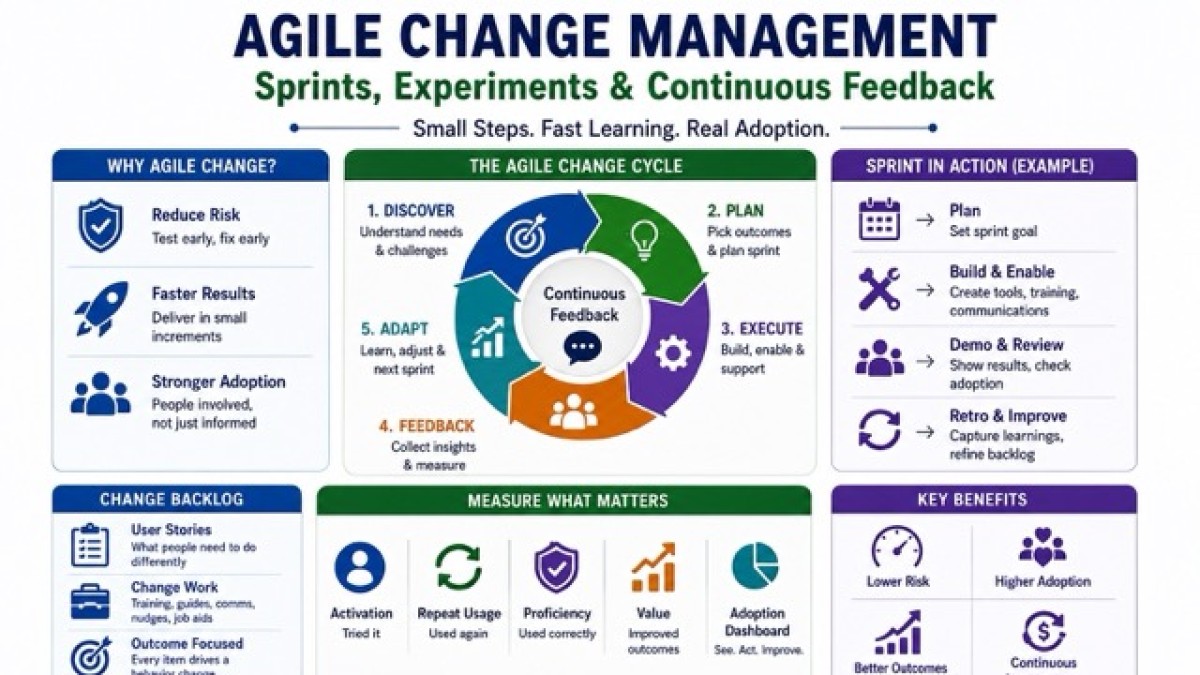
Run change in sprints with experiments and continuous feedback—not big-bang launches.

Most change programs fail for a boring reason. They bet everything on a big reveal.
A shiny launch. A one-time “go-live.” A training blitz. A town hall. An email cascade. A dashboard that looks healthy because it measures activity, not adoption. Then real work begins.
Users struggle quietly. Workarounds bloom. Local teams “do what they must” to hit targets. Leaders interpret silence as acceptance. The change team interprets completion of deliverables as success. And the organisation drifts back to old behaviour; only now with extra steps.
Agile change management is a direct rejection of that bet.
It treats adoption as something you build, not something you announce. It blends agile delivery principles with change practices so you can ship improvements in small increments, learn fast, reduce risk, and create real ownership; because the people affected are part of the cycle, not recipients at the end.
This article shows how.
What Agile Change Management actually means.
Agile change management is not “doing change faster.”
It’s doing change in shorter cycles, using pilots and experiments, and running continuous feedback loops that shape the next iteration.
In practice, it means you stop thinking in “phases” (design → build → roll out) and start thinking in sprints (discover → try → learn → adjust → expand).
You blend:
- a) Agile delivery principles: small increments, backlog, sprint planning, demos, retrospectives, cross-functional teams.
- b) Change management practices: stakeholder mapping, impact assessment, comms, training, sponsor alignment, resistance management, reinforcement.
The output of each sprint is not just “features delivered.” It’s behaviour moved.
Why traditional change feels risky (and why agile reduces that risk)
Traditional change is risky because it’s built on assumptions that stay untested too long:
- a) “People will understand the why.”
- b) “Training will be enough.”
- c) “Managers will reinforce.”
- d) “The new process fits the real workflow.”
- e) “The system is intuitive.”
If you validate those assumptions only after a full rollout, the cost of fixing them is high. By then, politics is high. Fatigue is high. Trust is fragile.
Agile change reduces risk by shrinking the distance between decision and reality:
- a) Short cycles expose issues early (before they harden into resistance).
- b) Pilots reveal local constraints and hidden dependencies.
- c)Rapid feedback prevents “perfect on paper, painful in practice.”
- d) Incremental rollout avoids organisation-wide disruption.
Risk doesn’t disappear. It becomes manageable.
The Agile Change Operating System.
Here’s a practical operating system you can run, whether you’re changing a process, a digital tool, a policy, or a service model.
1) Build a Change Backlog (not a “change plan”)
A traditional change plan lists activities: training, comms, FAQs, roadshows. A change backlog lists adoption outcomes and the smallest steps to get there.
Think in “user stories,” but for behaviour:
- a) “As a Relationship Manager, I can capture KYC documents in one flow so I don’t keep separate trackers.”
- b) “As a Site Engineer, I can log incidents in under 2 minutes so I don’t delay reporting.”
- c) “As a Gym Front Desk Executive, I can handle complaints consistently so members don’t feel brushed off.”
Then attach “change work” to each story:
- a) Quick guides
- b) Micro-training
- c) Manager coaching prompts
- d) Updated SOP snippets
- e) In-app nudges
- f) Role-based comms
- g) Job aids
- h) Reinforcement routines
Key shift: delivery items are not “nice-to-have.” They are part of the product.
2) Sprint Planning: pick outcomes, not activities
In sprint planning, ask three hard questions:
- What behaviour will be different at the end of this sprint?
- Who must do it differently, and what will block them?
- How will we know it’s happening in real work?
You then select backlog items that directly enable that behaviour.
A good sprint goal looks like:
- a) “Collections team logs 80% of follow-ups in CRM for pilot region A with less than 10% rework.”
- b) “Procurement users complete the new vendor onboarding checklist with cycle time under 48 hours for 20 pilot vendors.”
- c) “Branch teams use the new incident reporting format for all safety incidents for two weeks.” Now the sprint has teeth.
3) Run Change Sprints with a predictable cadence. A change sprint often mirrors a delivery sprint (1–2 weeks is common):
- a) Day 1: Sprint planning + stakeholder check
- b) Days 2–6: Build + enable + field support (office hours)
- c) Day 7/10: Demo + adoption review (what users experienced)
- d) Final day: Retro + backlog refinement
The change team stops living in PowerPoint and starts living in the workflow.
4) Demo Days: show reality, not slide. A change demo is not a presentation.
It’s a live walkthrough of:
- a) What the team shipped (job aid, updated form, system tweak, SOP change)
- b) What users tried
- c) What users struggled with
- d) What will change next sprint
If you want ownership, you must make the work visible and discussable.
Even better: let pilot users demo how they used it in their day. That single move does more for credibility than ten sponsor emails.
5) Retrospectives: treat resistance as data: Retrospectives are where change maturity shows up.
Instead of “people are resisting,” ask:
- a) What part of the change is expensive for users (time, effort, risk)?
- b) What uncertainty remains? •Where are managers not reinforcing (and why)?
- c) Which policies or measures conflict with the new behaviour?
- c) What workarounds appeared and what do they reveal?
Resistance becomes a diagnostic tool. You don’t “manage” it. You learn from it.
Experiments: the fastest path to adoption.
Agile change is powered by experiments. Not endless pilots. Not “trial runs” with no conclusion.
Real experiments have:
- a) A hypothesis
- b) A defined test group
- c) A success metric
- d) A time box
- e) A decision (scale, adjust, stop)
A simple experiment template
Hypothesis: If we add a 3-step call script and a one-page objection-handling aid, first-call resolution will improve.
Test group: 2 teams in one region for 2 weeks.
Metric: First-call resolution + average handling time + customer satisfaction.
Qualitative feedback: daily 10-minute huddles + tagged comments in a simple form.
Decision rule: Scale if FCR improves by X without harming AHT beyond Y.
This turns change from opinion to evidence.
Continuous feedback loops: the engine of agile change.
Feedback is not a survey at the end. It’s a system you run every week.
The four feedback loops you need
- In-the-flow feedback (micro):
Short prompts embedded into work: “Was this step clear?” “What blocked you?”
Example: after submitting an incident report, a 10-second “What was hard?” field.
- Manager reinforcement loop (weekly):
Managers’ report what they observed: compliance, confusion, pushback, workarounds.
Example: a weekly 15-minute “adoption stand-up” in each team.
- Operational metrics loop (continuous):
Track real usage, cycle time, error rates, rework, escalations.
Example: CRM login is meaningless; opportunity updates per active user per week is meaningful.
- User council loop (biweekly/monthly):
A rotating group of real users who review changes, give feedback, and co-design. Ownership rises when people can shape what shapes them. When these loops run, you stop guessing.
How short cycles, pilots, and rapid feedback improve adoption
1) They reduce risk by making failure cheap. Big-bang change makes failure expensive. Small-batch change makes failure informative.
Example: ERP procurement module rollout Instead of rolling out
Instead of rolling out to all sites at once:
- a) Sprint 1: pilot one category (e.g., stationery) with one site
- b) Sprint 2: add two more categories + refine approval routing
- c) Sprint 3: expand to three sites + role-based micro-training
- d) Sprint 4: scale with confidence because the workflow was proven in reality
Issues show up early: vendor master data problems, approval bottlenecks, unclear responsibilities, missing SOP steps. You fix them before they become organisation-wide pain.
2) They increase ownership because users become co-builders. Ownership isn’t a slogan.
It’s a result of involvement. When pilot users:
- a) Help prioritise backlog items
- b) Validate job aids
- c) Demo successes
- d) Shape the next iteration
…they stop being “people impacted” and become “people building.”
Example: New incident reporting format in an EPC environment
If site supervisors and safety officers co-design:
- a) The incident categories
- b) The minimum required fields
- c) The escalation triggers
- d) The “2-minute reporting” path for on-ground realities
You get compliance without constant policing. Because the design respects the field.
3) They improve adoption by aligning change with real constraints
Most adoption problems are not emotional. They’re structural:
- a) Forms take too long
- b) Approval chains are unrealistic
- c) Data fields don’t match reality
- d) Incentives reward old behaviour
- e) KPIs punish the new behaviour
Short cycles uncover these conflicts early.
Example: Sales CRM adoption. If salespeople are measured on calls and closures, but CRM updates take 15 minutes per client, they will skip it.
An agile sprint might deliver:
- a) A simplified “minimum viable update” workflow
- b) Auto-population of fields
- c) A manager dashboard that rewards quality updates
- d) Weekly coaching prompts for pipeline reviews
Adoption improves not because people “buy in,” but because the system stops fighting them
A practical model: The 6-Part Agile Change Stack
Use this as your blueprint.
- Change Vision (stable): One clear “why” and the outcome you want. This doesn’t change every sprint.
- Change Backlog (adaptive): A ranked list of behaviour-focused items.
- Sprint Cadence (predictable): 1–2-week cycles with planning, build/enable, demo, retro.
- Experiments (evidence-driven): Hypothesis-led tests with metrics and decisions.
- Feedback Loops (continuous): Micro, manager, metrics, and user council loops.
- Reinforcement (non-optional): Manager routines, recognition, consequence management, process governance.
If reinforcement is missing, agile just makes you fail faster.
Roles: who does what in agile change.
Agile change fails when accountability is fuzzy.
Here’s a clean way to structure it:
- a) Sponsor: removes barriers, sets priorities, enforces trade-offs.
- b) Product Owner (for change): owns backlog priorities based on adoption value.
- c) Change Lead: designs enablement, comms, training, reinforcement; runs feedback loops.
- d) Scrum Master / Agile Coach: protects cadence, improves team flow, removes blockers.
- e) Process Owner / Ops Lead: ensures the change fits operational reality and is governable.
- f) Local Champions: run local pilots, gather feedback, support peers, surface issues early.
- g) People Managers: reinforce behaviours weekly; they are not “informed,” they are responsible.
In agile change, “manager buy-in” is not a milestone. It is a weekly activity.
What Agile Change looks like in the real world (three examples)
Example 1: Rolling out a new customer complaint resolution process (service business)
Goal: reduce complaint resolution time and improve consistency.
Sprint approach:
- a) Sprint 1: pilot complaint register + 3-tier escalation for one location
- b) Sprint 2: refine categories + create micro-scripts + introduce daily 10-minute review
- c) Sprint 3: add dashboard + train managers on reinforcement conversations
- d) Sprint 4: scale to 5 locations + introduce recognition for first-time resolution
Feedback loops:
- a) Frontline 10-second friction notes
- b) Manager weekly adoption stand-up
- c) Metrics: closure time, reopen rate, CSAT trend
- d) Monthly user council with rotating reps
Result: people adopt because the workflow becomes easier and visibly supported.
Example 2: Introducing a new approval policy (finance / procurement)
Goal: reduce maverick spend and improve control without slowing operations.
Experiment:
- a) Hypothesis: a simplified approval matrix + pre-approved vendor list will reduce cycle time and improve compliance. b) Test: two departments for 3 weeks.
- c) Metrics: approval cycle time, exceptions, escalations, purchase value leakage.
Sprint outputs:
- a) Clearer matrix (not a complex policy PDF)
- b) One-page job aid •escalation rule for urgent purchases
- c) Weekly sponsor review of exceptions
Result: compliance rises because “how to comply” is designed, not assumed.
Example 3: Updating field reporting in a construction project environment
Goal: increase reporting accuracy without increasing admin burden.
Sprint 1: minimum viable reporting format (2 minutes)
Sprint 2: add photo evidence + simplified categories
Sprint 3: manager reinforcement routine + audit sampling
Sprint 4: scale to all sites with champions and office hours
Key insight found early: connectivity issues and device constraints solved before scale.
Result: adoption improves because the change respects field reality.
Adoption metrics that actually matter (and how to use them in sprints)
Avoid vanity metrics:
- a) “Number trained”
- b) “Emails sent”
- c) “Logins”
Use adoption metrics tied to work:
- a) Usage quality: % transactions completed end-to-end in the new way
- b) Cycle time: time to complete the new process vs baseline
- c) Error / rework rate: corrections, reversals, duplicate entries
- d) Escalations: where people get stuck
- e) Workarounds detected: shadow trackers, offline approvals
- f) Manager reinforcement frequency: weekly check-ins done or not
- g) Confidence & clarity pulse: 2–3 questions, every sprint
Then use these metrics as sprint inputs:
- a) If quality is low → simplify workflow and job aids
- b) If cycle time spikes → remove friction or add automation
- c) If escalations spike → improve decision rules and manager
coaching Agile change is not “measure for reporting.” It’s “measure for steering.”
- Agile theatre: Daily stand-ups, fancy boards, no behavioural movement.
Fix: define sprint goals as behaviour + measurable adoption. - Too many pilots, no scaling: Testing becomes hiding.
Fix: every experiment needs a decision rule and a scale plan. - Change team is disconnected from delivery: Delivery ships features; change ships comms. Users suffer.
Fix: integrate change work into the backlog and sprint cadence. - Reinforcement is optional: Managers don’t coach, sponsors don’t enforce, adoption stalls.
Fix: manager routines and sponsor decisions are sprint backlog items too. - Feedback is collected but ignored: Nothing kills trust faster.
Fix: close the loop every sprint: “You said → we did.”
A compact playbook to start next week.
If you want to shift to agile change quickly:
- Pick one change initiative with visible pain and clear stakeholders.
- Define a 2-week sprint cadence.
- Create a change backlog using behaviour-based user stories.
- Choose a pilot group with real work volume and a supportive manager.
- Set three adoption metrics that reflect real usage quality.
- Run demo + retro every sprint no exceptions.
- Establish office hours during the pilot (support in the flow).
- Make managers run a weekly reinforcement routine.
- Publish a simple sprint note: what changed, what we learned, what’s next.
- Scale only when the workflow works in reality, not in slides.
Closing: Agile change is change with humility
Traditional change often behaves like certainty: “We know the solution. Now adopt it.” Agile change behaves like humility:
“We have a direction. Let’s learn our way into adoption.” Sprints keep you honest. Experiments keep you evidence-led. Continuous feedback keeps you grounded in how work truly happens. The payoff isn’t just speed.
It’s lower risk, because you don’t discover failure after scale. It’s higher ownership, because users become contributors. It’s better adoption, because the change evolves around real constraints, not imagined ones.
In the end, agile change management is a simple discipline: Stop announcing change. Start iterating behaviour.
Categories: : Management